


Some cities begin in a museum.
You enter. You walk. You stop in front of a painting by Dürer. Or by Goya. It doesn’t matter. Looking is what the painting lets you do.
It gives you a gaze — its interpretation of reality and the representation of it. You place yourself at the right distance from the canvas and you see it. You see its gaze. And you see yourself.
I think of The Burial of the Count of Orgaz, by El Greco. I studied it in seventh grade and I still remember the mnemonic. In Spanish, it was ARCA. In English, it becomes LACE: Landscape absent. Airborne robes. Cold colors. Elongated figures.
The rule fit in a margin of that history book, scribbled in blue Bic ink.
The Burial of the Count of Orgaz didn’t.
Above, a sky that is not the village sky. Below, the hidalgos looking at you as if the funeral were yours. Their gaze, somewhere between languid and curious, yet holding more answers than you do. Two levels that don’t line up. A space that never quite behaves the way it should.
Nobody called it a cube. They called it a flashcard.
As a girl, I devoured the books in my parents’ library. History books. Graphic novels. Photography books. The Larousse. A naval encyclopedia. Random things that hadn’t asked permission to share a shelf.
But above all, I looked at the art history books. And, well, the one about learning to draw like the great painters. I was naive. And a child. I still am.
I remember those books as if I were still sitting there, legs dangling from the chair, in secret before dawn. Armed with a flashlight.
Looking at art. Those failed attempts to explain to you, in a book, how to draw a bull: two ovals, a square, an inverted triangle here, et voilà.
A bull.
I wanted the charcoal to spill over. It wasn’t that I couldn’t follow the instructions. It was that I was looking for another language.
Mine, not the manual’s.
When I reached volume 9, I discovered Impressionism and fell in love. The smudge. The air. The hour. Until Cubism arrived in volume 13 and I forgot how to see the world without it becoming distorted in the act of looking.
Like when you look through a glass of water.
What’s behind it is still there. But the glass twists it.

Cubism demands something of you and respects you.
It demands something of you because it doesn’t hand you the instruction manual: the painting resolves here, the figure is here, the vanishing point is here, sit down.
It respects you because it doesn’t treat you as someone who has to be led by the hand to meaning.
It turns you into the Allen key.
Cubism hands you the chipboard panels and doesn’t tell you what a table is.
Whether they become a table or not is up to you.
Aha. It looked like a shelf. Now I see the table.
I don’t know if we’re growing docile or comfortable — if not outright lazy. Maybe both. Now people, messages, and brands: we’re all becoming easier and easier to look at.
As easy to look at as a naked Maja. Or a clothed one. But a Maja.
We lie down on the branding couch and let ourselves be looked at, asking nothing of the eye beyond contemplation.
—Oh, look at her. What a beauty.
Such precision in the stroke of that tagline. Such intention behind the volume of that Pantone. How well the typography falls across the collarbone. How exquisite the strategy, hand behind the nape.
It’s all there.
Exposed. Lit. Explained. Pre-chewed.
You don’t have to step closer. To step back afterward. You don’t have to turn the glass. You don’t have to assemble anything.
The brand has already decided what you should look at, from where, and for how long.
Naked or clothed, it doesn’t matter. A Maja.
And I think it’s a strategic mistake. Because what doesn’t close demands something of us. Because what doesn’t close keeps working in parallel even as we scroll on.
You’ll probably forget the name, but not what it describes.
It’s the Zeigarnik effect. And it’s a nice one, because it’s about to explain something relevant to your brand and to your life: we remember better what was interrupted, what never quite closed, what still holds an open task inside us.
That’s why you still remember that ex who one day just vanished.
Not necessarily because they were the love of your life.
Because there was no ending.
Your head keeps trying to assemble a table with a missing piece. Goes back to the conversation. Moves a sentence. Changes the ending. Tries again.
Not because something is missing.
Because nothing quite closes.
We file away what ends. What doesn’t keeps working.
So perhaps incomplete isn’t the word.
Unresolved.
Cubism isn’t a puzzle with a stolen piece. It has planes to spare.
Face and profile. Head-on and from the side. Moments that shouldn’t fit together, sharing the same surface anyway.
Nothing is missing. All that’s left is for you to make the connection. To draw your own conclusion.
Aha.
A bull.
Aha.
That song seems to be the one listening to me.
Aha.
I’m obsessed with that brand. Don’t ask me why.
Like that conversation with that ex.
Like that painting that seems to look back at you.
Like an identity able to show all its faces without collapsing into one — until you look at it.
Maybe the next time you look at your brand you shouldn’t ask whether it’s understood.
Ask whether it ends when you stop talking.
If it’s all there — exposed, lit, explained — you’ve probably made a Maja.
She may be beautiful.
She may be naked.
She may wear an impeccable Pantone.
But she’ll go on lying on the couch, waiting for someone to contemplate her and scroll on.
Step back from the canvas.
If something comes with you, even if it doesn’t quite close, then yes.
There’s a bull.
There’s a brand.
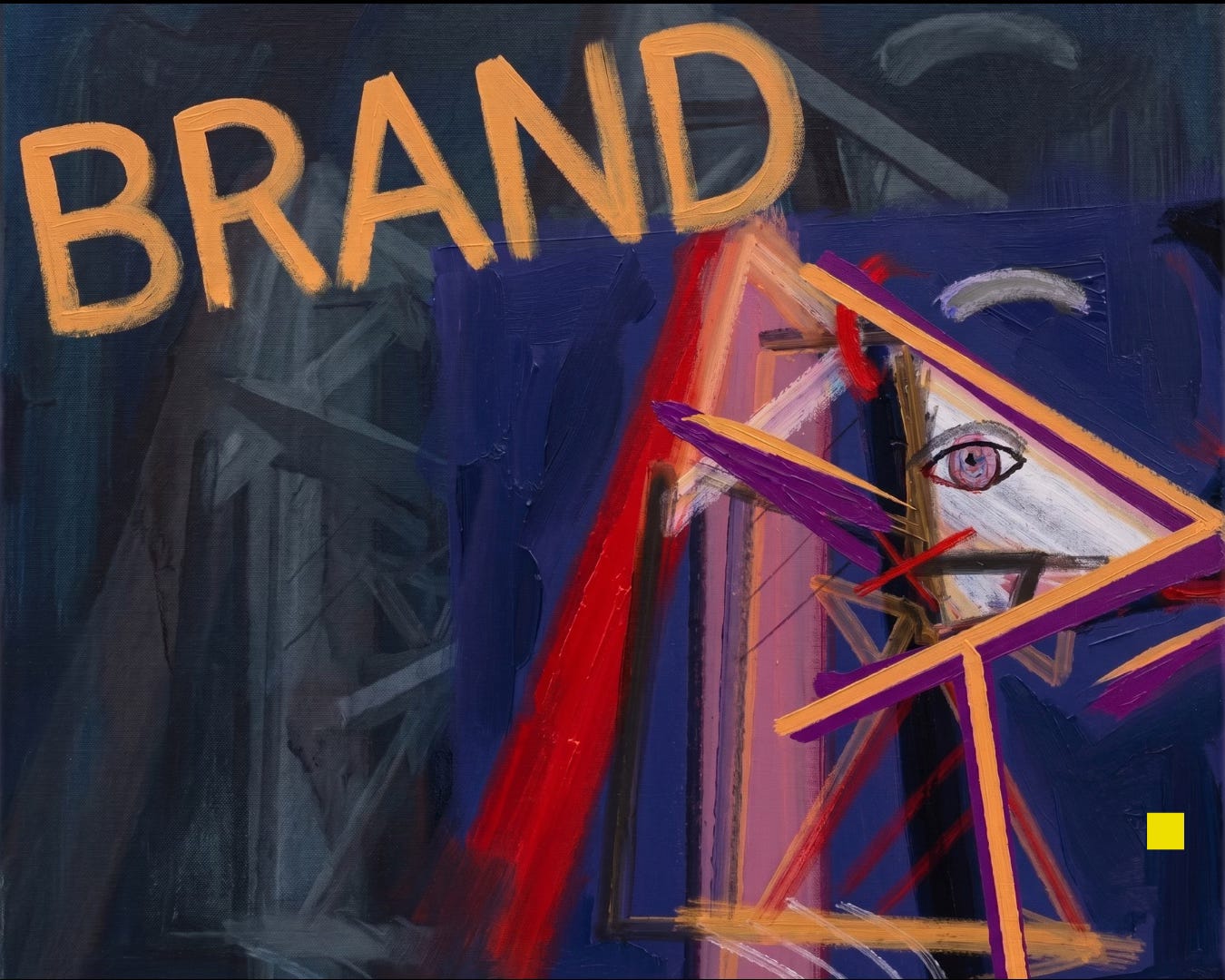
Some cities begin in a museum. I’ll walk into MoMA in early November. If you’re in the city, maybe we can look through the glass together.
Lines Aja
Brand Strategist & Verbal Identity Consultant — Las Musas®
cultooruido.com