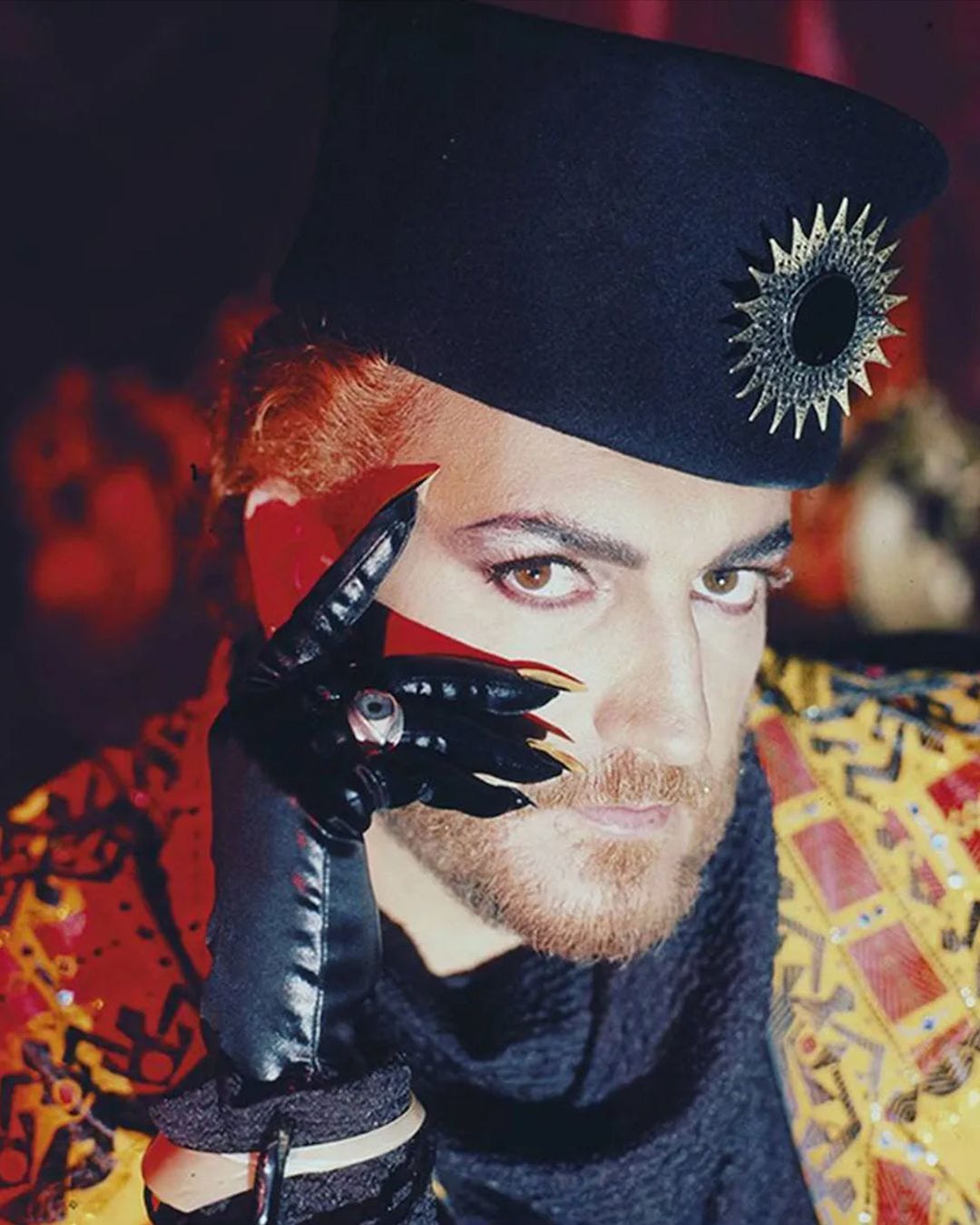

How do you get from a village of 300 people, lost in the Asturian mountains, to sharing tricks with Bowie on how to make shoulder pads more dramatic?
You leave with your ideas clear, your head high, and your chin set. Because you’re going to take hits.
And with shoulder pads — like with rouge — never enough, never too much.
He died on his way to the stage. The greatest hits album came out the next day. As scheduled.
Tino Casal. A baritone voice that some opera houses would kill for. The same man who recorded with the London Philharmonic at Abbey Road.
My family built things out of clay. Tejeros — brick makers. They had their own language for it: Xiriga, a dialect developed by the trade so the client wouldn’t understand the price negotiation happening right in front of him.
La Tamarga was named in that language. A pub that moved people from 150 kilometers away. Not because of the drinks. Because of what they played.
Some codes travel further than others.
Tino Casal also spoke in code.
Not because he was hiding. Because what he was saying didn’t have a translation yet. The shoulder pads, the eyeliner, the cane — not symbols. Not statements. A language. One that Spain would spend thirty years learning to read.
He knew it. “Every day I get bored of my image, but I can’t change it as fast as I’d like — the Spanish market wouldn’t absorb it.”
He wasn’t ahead of his time. He was on time. Spain was late.