

Criterion holds.
It’s easy to have an opinion. It’s easy to question. It’s easy to ride the trend.
What’s not so easy is to hold the reins, breathe deeper, think harder, and wait on the peak for the wave with your name on it to break.
The strategy is simple: going against the current means you have to paddle twice as hard.
Most people don’t. Most people stay where the water carries them — close to the shore, close to each other, close to whatever the tide is already doing. It’s not laziness. It’s economy. Going with the current saves energy, and energy is finite. The math works on paper.
What the math doesn’t tell you is where the current is taking everyone.
The thing is, once you reach the spot, you have more options to choose which wave to ride. The crowd thins out. The noise drops. The water moves differently when there are fewer bodies in it.
Out there you face your own threshold. No excuses. Just you and your board — call it a board, call it a strategy. You, your limits, your potential.
This is the part nobody warns you about: reaching the spot doesn’t make it easier. It makes it quieter. And quiet is where most people lose their nerve. With no one around to tell you what to do, the only authority left is yours. With no current to carry you, you have to choose direction. With no crowd to imitate, you have to read the water yourself.
A few heads in the water will tell you there are safer zones. Easier sets. More obvious lines. They’ll say it kindly — they mean well, or they mean themselves well. Either way, the advice points back to where they are.
But your instinct knows something else. In this spot, where your endurance is your only competition, that’s where your wave breaks.
Not every wave is yours, even when it looks like it is.
There are inside waves — comfortable, predictable, obvious. They suggest a predictable move. Easy on your insomnia and your bank account. They come dressed up.
Mediocrity dresses up when it wants to take you to the dance floor.
The wrong wave never arrives as obvious noise. It arrives as opportunity. As timing. As now-or-never. It comes with a deadline and a smile. It comes with someone you respect telling you it’s a good idea. It comes wearing the clothes of the right wave — same color, same shape, almost the same break.
Almost.
Saying no to what comes badly wrapped is easy. Anyone can pass on what’s clearly noise. The discipline is saying no to what comes well wrapped and still isn’t yours.
That no costs more. That no looks like a mistake from the outside. That no is the one your friends will ask you about six months later — why didn’t you take it? — and you’ll have to explain something you knew in your body before you knew it in your head.
So you wait.
Not still — training. Watching the sets come in. Counting the rhythm. Letting the wrong waves pass under you while you stay on the board. Rehearsing the move again and again, ready for the moment.
Your moment.
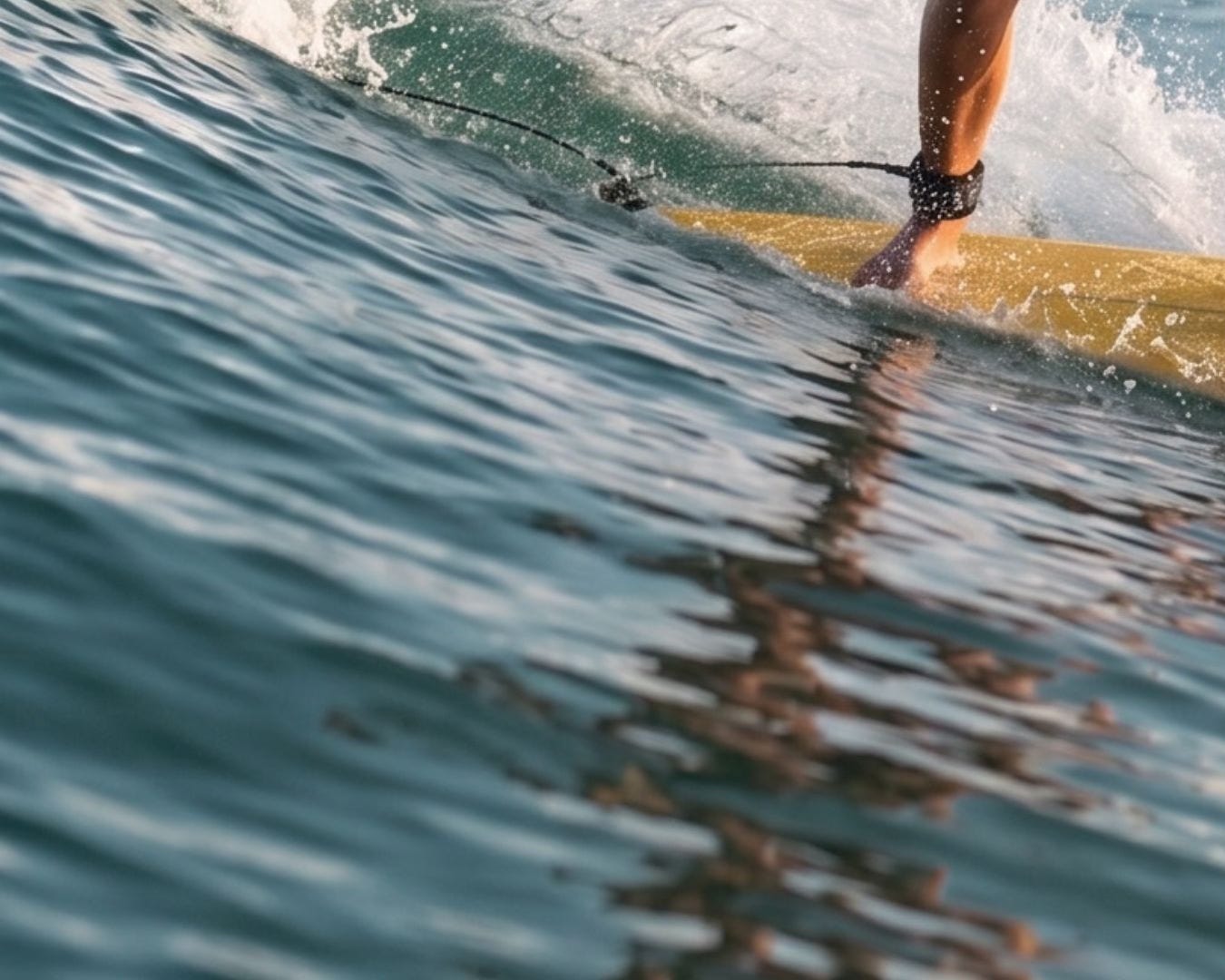
The wave with your name on it is recognized because it calls you.
Not loudly. Not with fireworks. The call is quieter than that — it’s the way the water shifts under your board a second before the wave arrives. The way your shoulders know to turn before your eyes do. The way you stop counting and start moving without deciding to start.
And that’s something you won’t learn from a prompt.
You can ask the right questions. You can collect frameworks. You can read every essay on positioning ever written. None of that teaches you to feel a wave forming behind you.
You learn that by catching waves that weren’t yours first — if you weren’t paying attention. Or if you were, by watching others reach the shore on a wave that never fully breaks.
Both teach. The first teaches you what wrong feels like in your own body. The second teaches you what wrong looks like from the outside.
Most people only learn from one of the two. They take wrong waves and call it experience. Or they watch others fail and call it caution. Neither is criterion.
Criterion is the third thing. The one that comes after both — the body that has been wrong, the eye that has watched wrong — and starts to recognize the difference before it happens.
Have you felt it before? The wave you didn’t take, that you watched roll in clean while you sat still on your board?
That sitting still wasn’t loss. That was the first time you knew.
Are you sitting on the board yet? Good. Don’t forget the sunscreen.
Your wave doesn’t come every day.
Sometimes it doesn’t come every week. Sometimes the whole season passes and you go home with sunburn and nothing to show for it on Instagram.
That’s also criterion.
The alternative — paddling for everything that moves, riding whatever breaks first, going home with footage of waves that weren’t yours — that’s a feed.
Criterion is what’s left when you stop performing the choice and start making it. It’s slower. It’s quieter. It looks, from the outside, like you’re doing nothing.
You’re not doing nothing.
You’re sitting on your board. You’re reading the water. You’re waiting for the one that came for you.
And when it does, you’ll know.
Because it will call you by your name.
Lines Aja
Brand Strategist & Verbal Identity Consultant — Las Musas®
cultooruido.com