

Gray hairs and all, maybe too old for certain things, I still get on the skateboard. Even when my knee gives out. Because I refuse to believe that cells — the ones in Excel, in Notion, in the calendar slicing up your day — are something to live inside instead of grind.
They ban playing ball the same way they ban thinking outside the box. Funny, considering “disruption” is what everybody sells. Or asks of you. Real disruption is almost never what people dare to do.
I’ve been seeing it clearly these days. Madrid does that to you when you come from a village. Your eyes fill with stimulus, concerts, conversations, nights that still seem to want something. And watching, listening, talking, you realise there are more kids wanting to kick the ball than ever.
The difference is that now the code, the algorithm, the pattern, the template slowly clip their wings — and bury the want in them.
That’s why I stopped when I saw this sign.
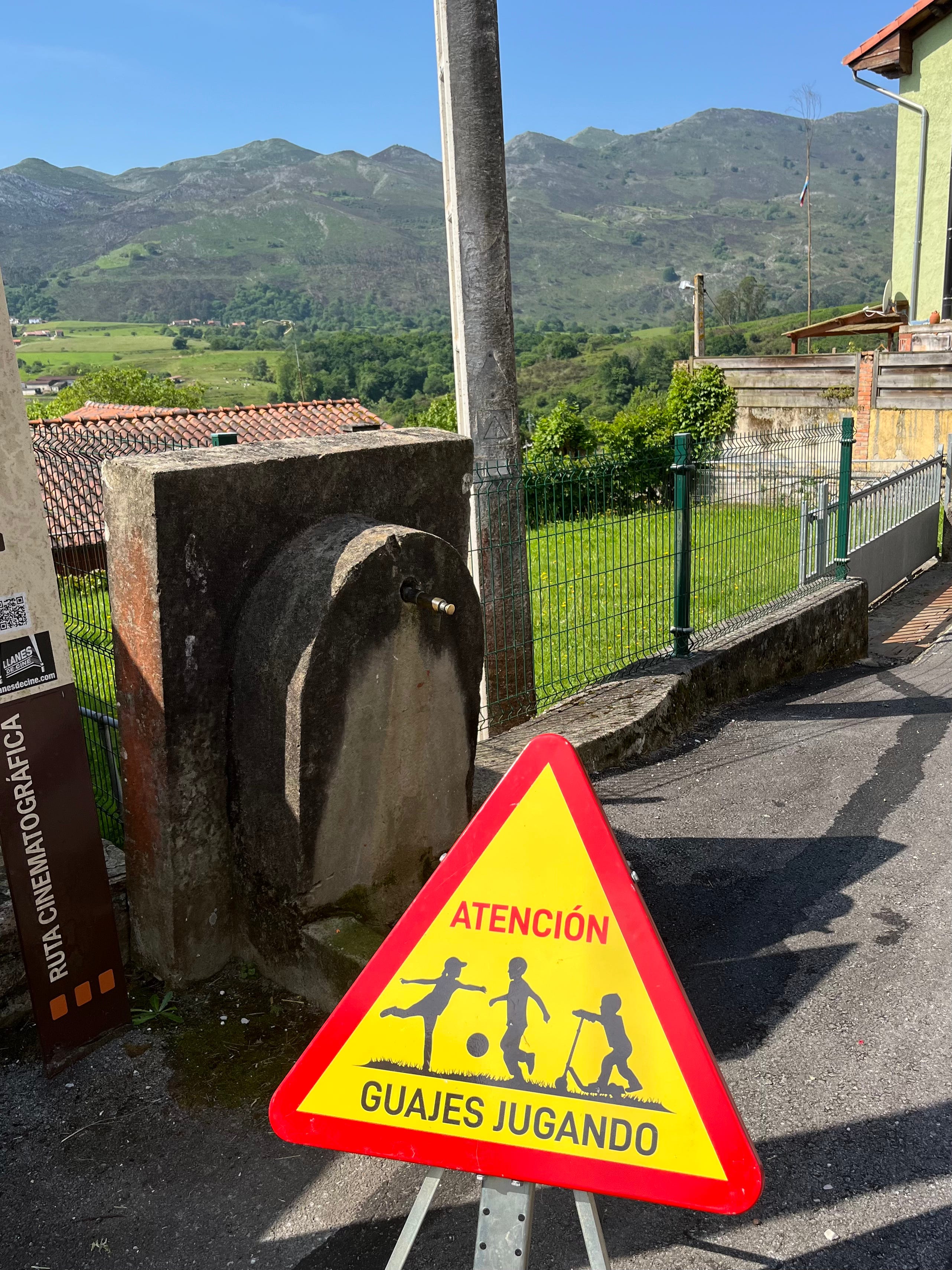
Guaje is what we call a kid in Asturias. A word from a language with no official status. A language that survives because people keep speaking it. On the streets. In the valleys. Around kitchen tables. In places where life happens before institutions get a chance to name it.
And there it was.
On an official road sign.
Not niños.
Not children.
Guajes.
A tiny act of cultural stubbornness. The kind I like.
Because the most dangerous things rarely disappear all at once. They disappear word by word. Game by game. Street by street. Until one day everybody is speaking correctly and nobody is saying anything alive.
Marketing does something similar. It fills the village square with signs.
Don’t write long.
Don’t lose attention.
Don’t go off-script.
Don’t make people think too hard.
Don’t risk being misunderstood.
The result is a world full of permission and very little play.
The brands that matter are built where culture, play and philosophy cross — by people willing to spray BAN BANNING across the wall and hand the street back to those it always belonged to.
Because creativity isn’t cool. That’s the lie they sell you. Creativity is rebellion with a purpose, practicing itself. Most days it feels closer to skating on a bad knee — walking the edge of a blade — than floating through clouds.
It’s risk. It’s friction. It’s refusing to let inertia, comfort or fear decide what gets built and what doesn’t. It’s running flat out after something that tastes like purpose.
A bruised knee. A chipped tooth. A scar or two. Scars, or stripes — from the skateboard they feel the same. Proof that you were here. Proof that you played.
The streets belong to us. We never left.
Lines Aja
Brand Strategist & Verbal Identity Consultant — Las Musas®
cultooruido.com
It is probably an exaggerated motto, but a word can change the way we perceive reality around us. Language can model my thoughts. I love to remember my mother mostly in Catalan, and anything expressed in Catalan — and also in Valencian — tends to evoke memories.
I deal with my public in Spanish and develop my creative concepts by applying word frameworks conceived in English. Certainly, I am also beginning to feel that language becomes a space of confronting identities in a world where identity becomes mixed and fluid.
Your post brings microscopic and local evidence that words change our worlds. A lot to think about, a lot to consider, and also a lot to care for.
Antonio Monerris Tormo