

Last week a friend wrote to me.
“I found this in my notes. It’s good. But I don’t know if it’s mine.”
She didn’t know if it had come from a conversation, a series, a book, a newsletter, or a machine. And honestly, it didn’t matter. Because the interesting question was never where it came from. The question was another one: what does this idea connect to inside you?
Silence.
Not because she couldn’t remember the source. Because she couldn’t remember the thread. She didn’t know what other ideas it joined, what problem it was trying to solve, what inner conversation had provoked it, where it was taking her.
The idea was there. But it seemed to have arrived complete. Like a found object.
Ideas have a history.
We don’t always remember where we first saw them, and it doesn’t much matter. No idea appears in a vacuum. We read, we listen, we copy, we mix, we forget. What matters isn’t the origin. It’s the mark the journey leaves.
The ideas that end up being yours rarely stay intact. They get contaminated. They mix with other readings, contradict themselves, strain against experience. They lose pieces, gain others, until they deform and come to resemble whoever thinks them more than whoever formulated them first.
That’s why some ideas you can trace backward. Not all the way to the origin, necessarily. But to the process.
You can explain what conversation activated them, what book gave them language, what experience made them inevitable, what contradiction forced them to evolve. You can pull the thread and it keeps appearing — like Ariadne’s, the thread that lets you walk the labyrinth in reverse.
Others, no.
Others arrive finished. Brilliant, polished, perfectly encapsulated. But you pull on them and nothing appears. No connections. No obsessions. No questions. No bridges. Just the sentence. As if it had landed directly on the page.
And that’s where the difference begins between repeating an idea and having thought it. Because thinking isn’t arriving at a conclusion. Thinking is knowing how to find your way back to it.
And building that road has a price.
Not a metaphor. A literal price.

We’re used to talking about ideas as if they were vapor.
As if they appeared from some abstract place called creativity. But thinking is a physical process. It burns glucose. It burns oxygen. It burns time. It burns your body. Every new connection has to force its way through a network that didn’t exist before. And forcing a path always costs energy.
The brain weighs roughly 2% of the body and yet consumes close to 20% of all the energy we spend. Around twenty constant watts. A bulb burning inside the skull.
Every time an idea moves, millions of neurons exchange electrical and chemical signals. Every connection has a cost. Every bridge burns fuel. Every crossing leaves a mark.
When you work those connections again and again, you become a contortionist. Not of the concept. Of the process.
A contortionist doesn’t master a posture because they’ve seen it. They master it because they remember every fall. The body keeps memory of each failed attempt, each loss of balance, each movement that didn’t work before finding the one that did.
Something similar happens with ideas.
When you return to an idea you’ve genuinely thought, you don’t repeat a routine. You come back with memory. You can explore variations. You can strain it. You can take it to new places. You can answer questions you’d never asked yourself. Because you know the terrain underneath.
Whoever copied the posture has the final photograph.
They might even get the applause. But they have none of the falls. And at the first variation — the first question the script didn’t account for — the spell breaks. There’s no memory of stumbling to pull from. No journey. No bridges.
The first time you hear one of your own concepts in someone else’s mouth, you doubt yourself.
Maybe it’s the red car.
You learn a word and suddenly it’s everywhere. You buy a red car and half the city is driving one. You name something and start seeing it repeated on every corner. Convergence, coincidence, the trap of attention suddenly hunting for what you’ve just learned to see.
Maybe that’s all it is.
Or maybe there’s something underneath, more uncomfortable. Because when an idea has been with you a long time, you develop an ear for it. You recognize its shape even when it changes clothes: other examples, other references, other words. And your shape underneath. And then the real doubt arrives.
Did we get to the same place by different roads? Are we looking at the same thing and naming it alike? Or did someone mistake proximity for authorship?
You can’t always know. But over time you learn to tell one thing apart: when an idea has roots and when it only has surface.
So let’s go back to the price.
A study estimated that transmitting information across the cortex burns far more energy than computing it. Not quite the same as thinking — but the ratio stays with you: moving something costs more than producing it. Connecting more than concluding. It costs 35 times more.
A penny for your thoughts.
I suspect the math falls short. The conclusion costs a penny. The bridges cost thirty-five.
Because the conclusion is the visible part. The result. The sentence. What anyone can repeat.
The bridges are something else.
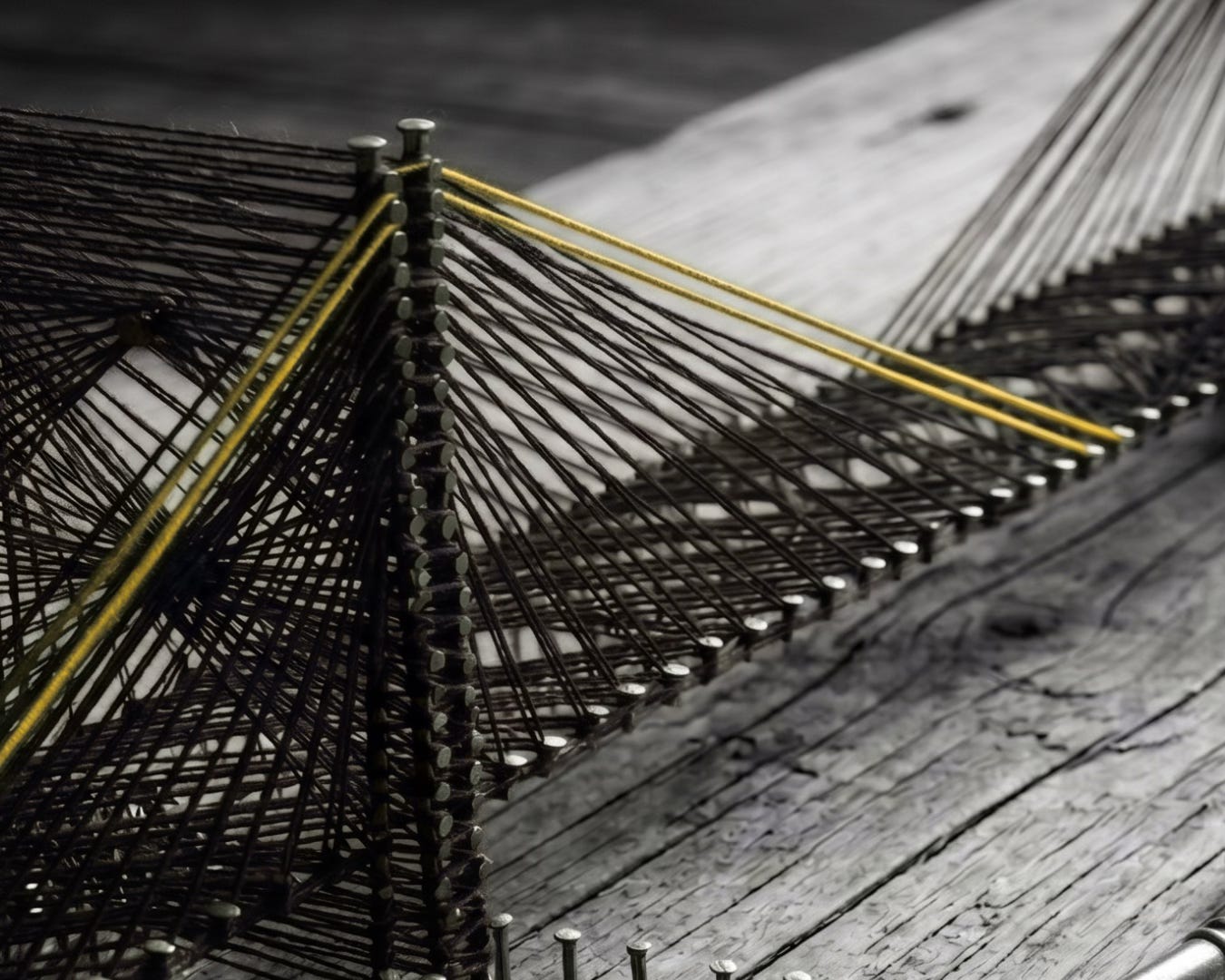
They’re the invisible connections that hold the idea up. The associations. The contradictions. The readings. The mistakes. The questions that made it possible to reach it.
That’s the seal. And the deal.
Not the idea. That’s the cheap part.
Your seal, the real deal, is the energy burned building the bridges. The heat accumulated in every connection. The thermal trace of having walked the road so many times you can return to it in the dark.
It’s the wax seal pressed while it’s still hot.
Take the line.
The seal was set hot. That one doesn’t lift.
Lines Aja
Brand Strategist & Verbal Identity Consultant — Las Musas®
cultooruido.com
The thirty-five is real, but borrowed. It comes from Levy and Calvert (PNAS, 2021): in the human cortex, communication burns 35 times more energy than computation. They were measuring neurons, not thoughts. The jump from one to the other is mine. So here’s the thread, if you want to walk it back
The tragedy of digital culture is that someone who copies content or an idea rides for free on a highway someone else had to hack through their own brain. They take the finished product without paying the biological toll of having failed and built the bridges. As you said, the conclusion costs a penny but the infrastructure is where the real debt is paid.
Loved this