

1:17 AM. I'm listening to a Jimi Hendrix born in Niger — if Hendrix had been born in the Sahel, this is what he'd sound like. And this might be the best story you'll read today — unless it’s still the best one tomorrow.
I don’t really know how I find the brands, the people, the clients, the songs that are meant for me. But I know they’re there. And the more I tune the inner ear, the more I align my synapses — I’m more about that than chakras — everything falls into place.
How does a musician from a village in Niger reach another village in Spain?
Mdou Moctar was born in Abalak, a village in central Niger. His family was religious. His environment too. Secular music was forbidden. So he did what people do when there’s no other option: he built himself a guitar out of bicycle brake cables. And he learned to play alone, in secret, listening to Abdallah Oumbadougou, the hero of Tuareg guitar.
He had no studio. No producer. No internet connection. In 2008 he recorded his first album, Anar, with a tape recorder and drum machines. And the songs began to travel from phone to phone, by Bluetooth, on memory cards, village to village across the Sahel. No Spotify. No algorithm. No marketing plan. Just the music moving on its own because it was good enough for someone to want to pass it to the next person.
A guy from Portland named Christopher Kirkley heard one of those songs on a phone file while traveling through West Africa. The file just said “Mdou.” It took him years to find the owner of that voice.
I reached out to Christopher. We talked. I had many questions, but in the end they all collapsed into one: which song was it? The one on that phone file. The one that made you spend years looking for a voice with no name.
His answer: Tahoultine.
Mine had been Chismiten. Same musician. Different entry point. Same pull.
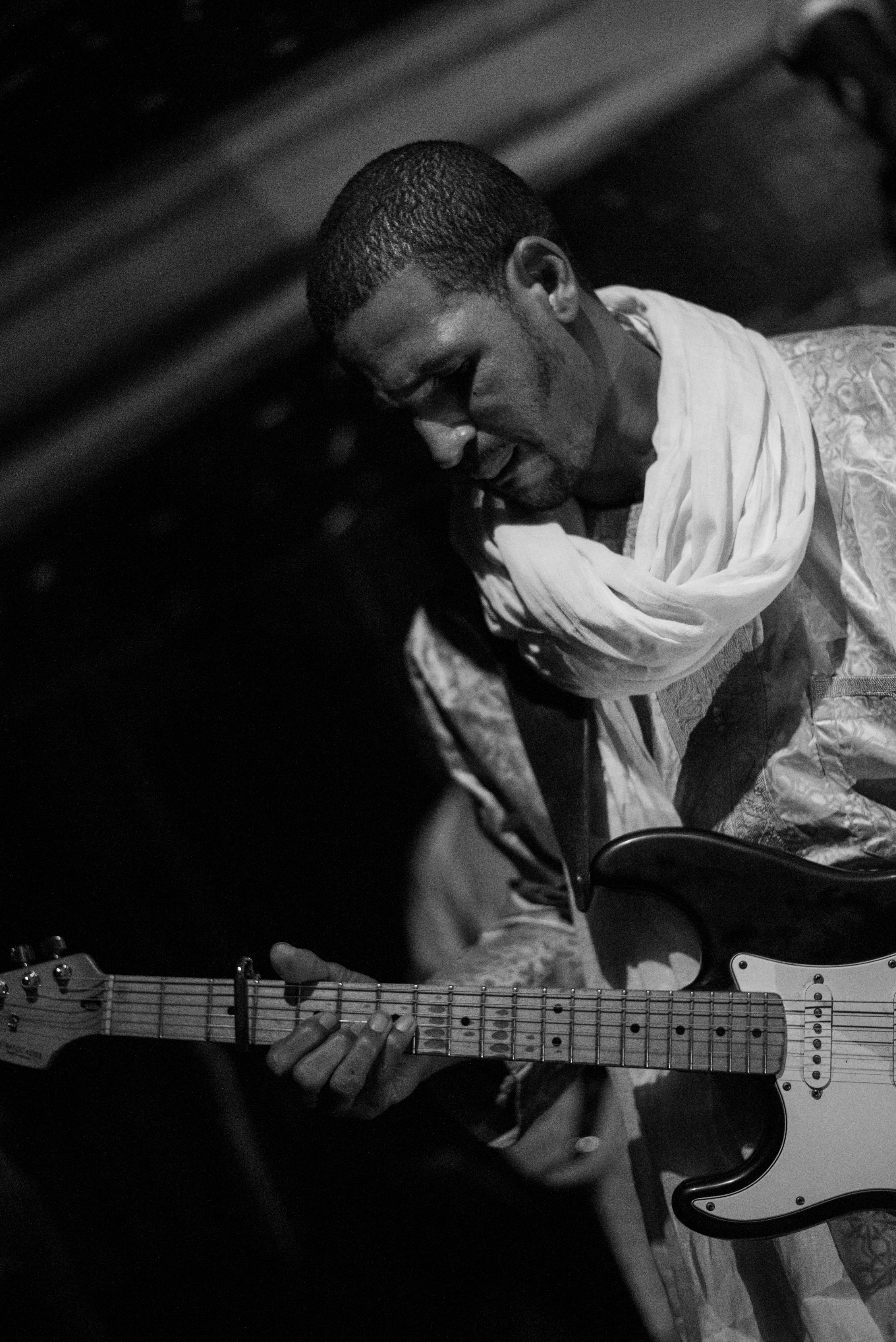
Mdou Moctar. Comet Ping Pong, Washington, D.C., 2017.
Image credits and eternal thanks: Christopher Grady
The first track I fell into was “Chismiten.”
A rooster crows. Footsteps on dry earth. Then the guitar enters like a sandstorm — syncopated riffs, delicious, a desert psychedelia that doesn’t ask for permission. He sings in Tamasheq, a language I don’t understand and don’t need to. The falsetto hooks you before meaning does. Sticky, hypnotic, something between a prayer and a scolding. A man who built a guitar from bicycle cables, singing against jealousy and self-doubt. In a language almost no one outside the Sahel understands. And filling rooms in Brooklyn.
You don’t know what he’s saying. But your body already answered.
Then came “Afrique Victime.”
Sung partly in French — the language of the colonizer — it’s a direct accusation: Africa is the victim of so many crimes. If we stay silent, they’ll annihilate us. He names Gaddafi, Mandela, the Arab Spring, the uranium France extracts from the Sahel while its military bases look the other way.
A journalist asked him why he denounces France in French. He answered: “It's like going to the bathroom in the shower. You can do it, but you don't want to sleep in it.”
And then there's the layer behind. The last minutes of the song are pure Tuareg psychedelic guitar, wordless, just fury and beauty. He stops denouncing and starts building. The protest becomes sonic architecture.
I was thinking about this moment of grace, this story. This musician, the song. And me, in that moment, listening to it with enough frequency and tuning — and enough ignorance of French — to search for the meaning. From there to the subtext. And from there to him.
Mdou Moctar. Or Sixto.
Because this is also the story of Sixto Rodríguez.
A Bob Dylan from Detroit. A construction worker, activist, and troubadour. A son of Mexican immigrants who got a record deal, put out an album, and sold a thousand copies. A thousand.
So while Sixto kept breaking his back on construction sites in Detroit, in South Africa his music had become the anthem of a generation rebelling against apartheid. In that country, he was selling more copies than Elvis. The records were scratched and banned to control a population hungry for change — which only fed his impact and the bootleg copies.
For thirty years, he had no idea.
Then a journalist walked into a record shop in Cape Town. Heard the story. Started a blog. Posted a photo of Sixto on a milk carton: “Missing. Have you seen this musician?”
One night the phone rang. On the other end — Sixto.
The rest is a documentary that won an Oscar. And a world tour where South Africa was the first stop. Where an old man with grey hair finally felt the warmth that cold Detroit had never given him.
And then they talk to you about marketing. About identity, purpose, message, coherence, storytelling, tribe, narrative.
What made Mdou build that guitar out of bicycle cables, it’s what kept Sixto on the scaffolding by day and on half-empty pub stages in Detroit by night. Their position in the world. That was clear. Their message was coherent. And it was sustainable — for them. Even if it meant risking everything. Because it was natural.
For me it’s natural to sit down and write every day. It’s my gym for the grey matter. My way of claiming myself and not losing track. In case I forget why I’m here. It’s not everything that fits in that beautiful brandbook I developed. It’s everything that overflows from it. And everything that holds it up.
Your product is not the problem. You’re just not in the right transmission yet.
If what you do is good enough to travel — it will. Not because you pushed it. Because someone couldn’t keep it to themselves — by Bluetooth, by word of mouth, by a blog with a milk carton — then it’s just a matter of frequency.
But there’s a moment before the frequency finds you. Before the band enters.
There’s a lone guitar. A single note with reverb, filling the space around you. Nothing happens, but something happens. You want to hear more. You don’t know why you’re still here, but you’re still here.
That’s “Tarhatazed.” That was the first track I saved. Three chords in, before I knew anything — his name, his village, the bicycle cables, the Bluetooth tapes. Before meaning. Before language. Just a sound in the dark that made me press the heart.
Not the frequency you broadcast. The one that recognizes you.
Along the way I met Christopher Grady — a photographer who saw Mdou live twice and gave those moments a frame. He shared his photos with me. We talked. Different Christopher, same frequency.
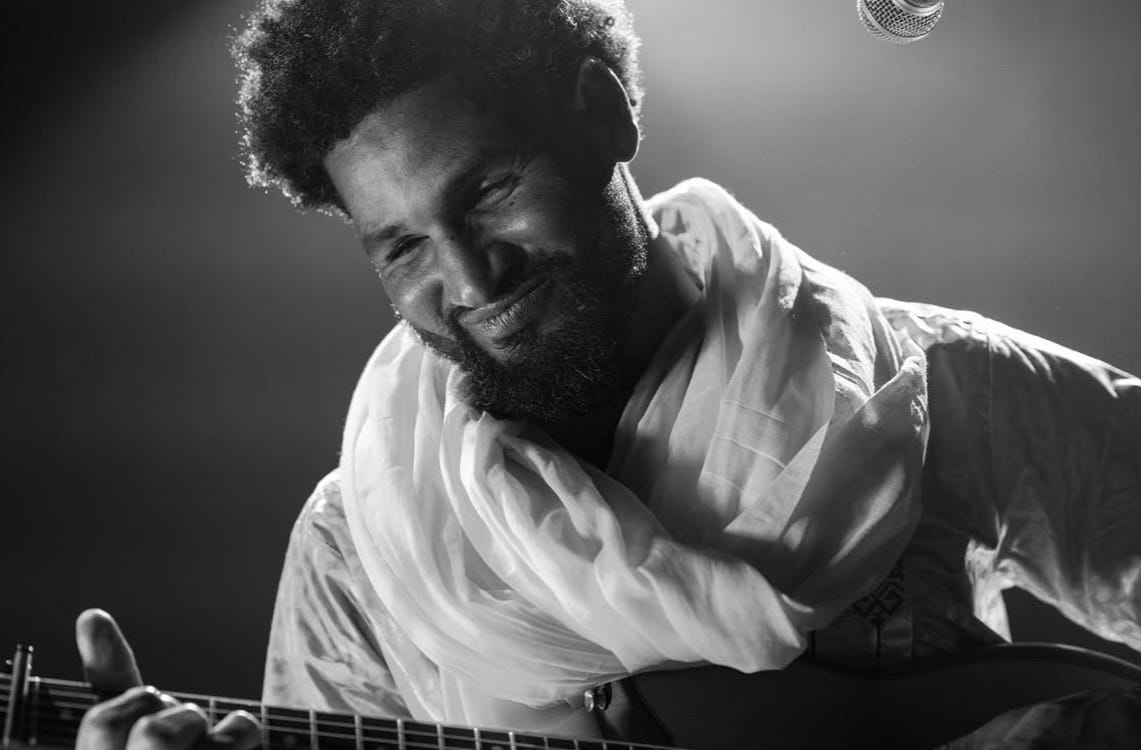
Mdou Moctar. Atlantis DC, 2026.
Image credits and eternal thanks: Christopher Grady
Lines Aja
Brand Strategist & Verbal Identity Consultant — Las Musas®
cultooruido.com