

I’ve been reading Joe Burns for a couple of years.
I know because LinkedIn reminded me of our anniversary a few days ago.
A sentimental algorithm.
Like your assistant. Or so some people say.
Anyway.
Joe is the influence I deserve.
I like his edge. He makes my neurons do CrossFit before breakfast.
And, above all, he doesn’t chew things up for me so I can swallow a great revelation and integrate it into my life.
I get plenty of aha moments, don’t get me wrong.
But since I’ve known him, he always seems to take me to the next thread.
A few weeks ago, he published a small work of art: Your Job Is a Lagging Indicator.
If you read me, you know I’m a fan—or rather, a hater—of labels.
His piece was partly about that.
As Joe puts it: the job you have describes the past.
Markets move first. Organisations second. Duties next. Roles last.
By the time a title exists, the work that needed it has already changed clothes.
I answered him there:
We tend to think people fail to fit categories. Maybe categories simply expire before people do.
That’s why so many spend years believing they’re too broad, too curious, too inconsistent, when they were just working inside a present that didn’t have a category yet.
We don’t build the future by imagining it. We build it by noticing which assumptions have already stopped being true.
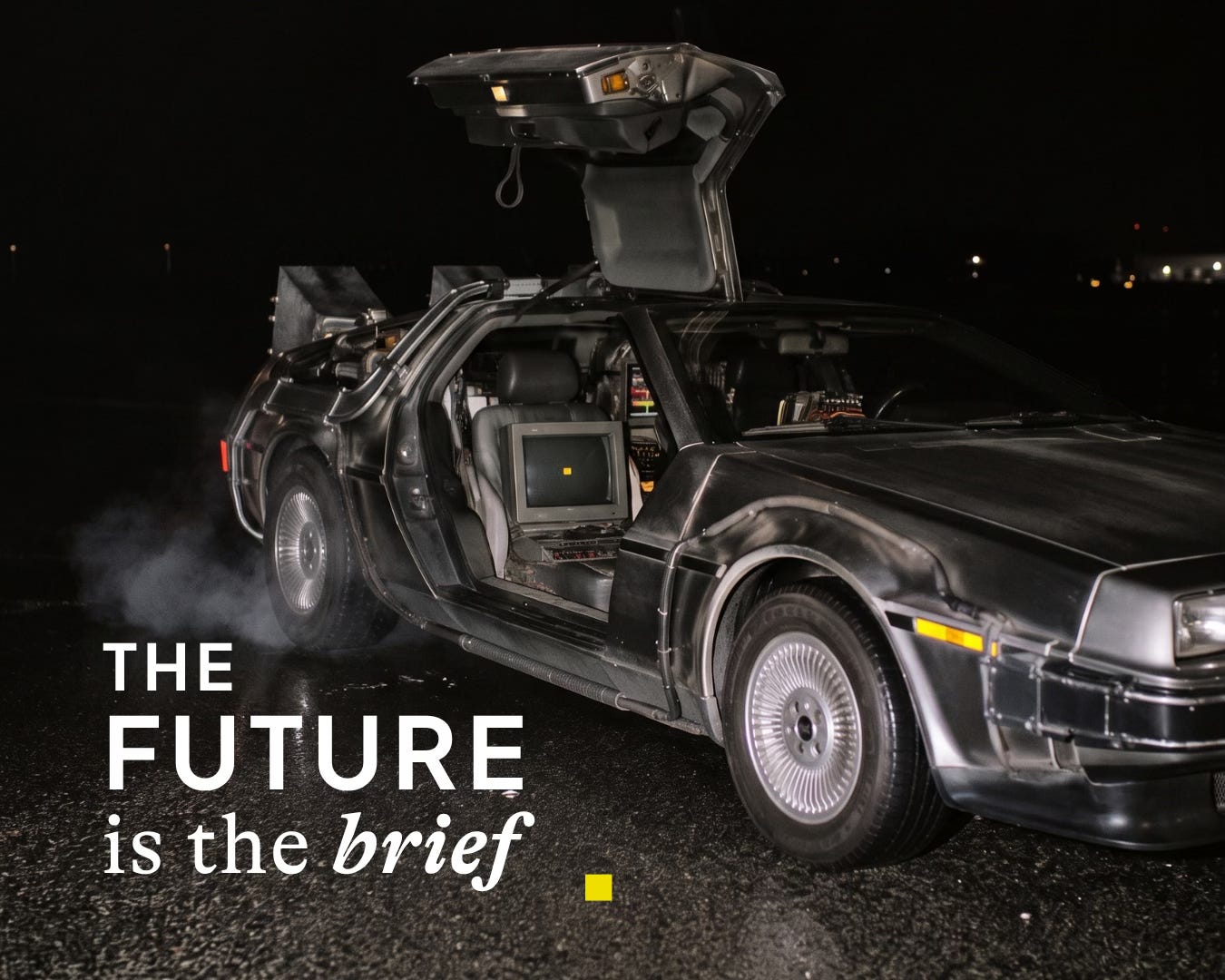
The future is the brief. The naming comes after.
So.
What’s the point of making a thousand calculations, reading the context, doing the fucking benchmarking and everything else?
I'm not saying you shouldn't do any of it.
But notice that you keep building for a market, a target, a client that is no longer the same one you had when the pitch started.
We try to predict.
We justify every decision.
And we forget two things.
To look at the real client. To see who the fuck they actually are. And align that with the gap we've found — and with what they're able to hold.
And to trust our instinct more often.
Labels arrive late.
They stigmatise. They become self-fulfilling prophecies.
And, if you let them, they jibarize you.
This is what jibarizing means: taking a full-sized human head and turning it into a skull the size of a keyring.
A Labubu from the Amazon rainforest.
Another kind of merchandising.
Polarisation. Scroll. Bots. Prompts.
And the bland taste of bread without salt.
Fatigue. Boredom.
Nothing new.
Only now, instead of getting it compressed into the evening news, we get it optimised into a carousel.
Maybe that’s why I still think anthropology has more to tell us about what’s coming than the marketing of what’s next.
The future is the brief.
So is the present.
Think about it the next time you write your questions down.
The best influence is punk: Joe Burns
Your Job Is a Lagging Indicator
Lines Aja
Brand Strategist & Verbal Identity Consultant — Las Musas®
cultooruido.com
I read Joe Burns’s article. At first, I thought it had nothing to do with me, although I understand the point and the idea, and I would say you are right. Then I thought that on this side of the world, those business models are copied and, once they work over there, they are only just beginning here, with the delay that comes from the fact that the position already exists there but still doesn’t exist here. It’s strange because you could follow leading companies in real time, but well, the context and the conditions are not the same.
Then I realized that in our architecture studio we had done something similar. One day, while reading Paulo Mendes da Rocha, he was commenting that when he had an idea, he would call the structural engineer to check whether the proposal was viable and to get an idea of the size of the structure. That’s when I came up with a solution to a problem we had in the studio: bringing in a profile without a name or a precise definition.
We partnered with a construction technician with a great deal of experience. He designed plumbing and electrical systems, had experience managing workers, preparing construction budgets, and renting machinery. With an idea that was still very incipient, I would discuss my first proposals with him. He could help me understand how many people we would need, how long it might take, what the approximate cost would be, and what size the structural elements might be.
I realized that many times, in our practice, we had to go back to the drawing board because a solution was too expensive or too complex. The idea behind bringing him in was to incorporate reality before the idea moved too far forward, to obtain a more honest and fluid result, instead of having a previous image that we would then try to build in a forced way, while also reducing the chances of having to go back.
I wouldn’t know what to call the position he held; he was simply the engineer. But his expertise participated in different layers of the process. I don’t know of any studio that works with this kind of profile. Usually, the idea is developed first and then the engineering disciplines are brought in, and sometimes they end up modifying the initial project quite substantially.