


The first thing they teach you in business school — before PESTLE, before Porter, before anyone mentions a pitch deck — is the SWOT.
Strengths. Weaknesses. Opportunities. Threats.
Four quadrants. One matrix. A neat little square that’s supposed to contain reality. And the lesson everyone takes from it is: maximize strengths, minimize weaknesses, watch for threats, chase opportunities.
That’s not what I learned.
What I learned — before I knew the framework had a name — is that the quadrants bleed. That every weakness is a strength wearing different clothes. That every threat is an opportunity that hasn’t turned around yet. And that the people who change things are never the ones with the best cards. They’re the ones who play the cards they were dealt as if they chose them.
There’s a woman who understood this better than any MBA program ever could.
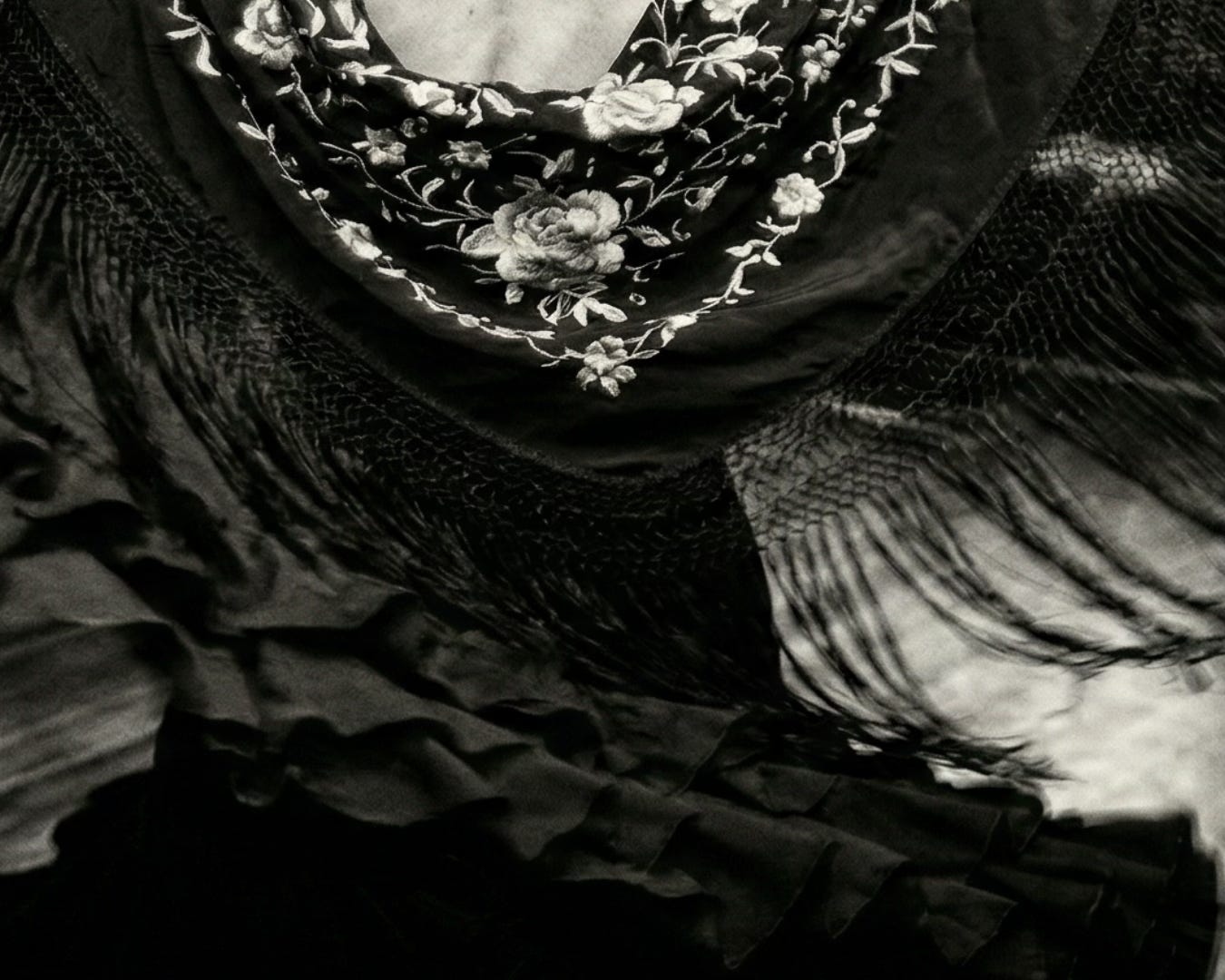
In 1953, Lola Flores — a flamenco singer and dancer— performed in New York. The story goes that The New York Times published a review that read:
“She can’t sing. She can’t dance. Don’t miss her.”
The review never existed.
No one has ever found it in the Times archive. EFE Verifica confirmed it. A professor from the University of Cádiz who wrote a book about her put it plainly: she probably made it up herself and used it as her own slogan. An “animal of communication,” he called her.
Think about that. She took what would be the most devastating critique imaginable for a performer — she can’t do the two things she’s paid to do — and she turned it into her tagline. She wrote her own weakness. Then she made it her territory. The quadrants didn’t just bleed. She ripped the grid apart and rebuilt it as a stage.
In 1983, her daughter Lolita was getting married in Marbella. Lolita had gone on national television weeks earlier and invited all of Spain to the wedding. All of Spain showed up. Five thousand people crammed into a church built for twelve hundred. The priest couldn’t officiate. The bride was crying in a corner. The groom was being shoved around by strangers in swimsuits.
Lola, dressed in pale pink, turned to the crowd and screamed:
“Mi hija no se puede casar. Si me queréis, irse.”
“My daughter can’t get married. If you love me, leave.”
The grammar was wrong. In proper Spanish, it shouldn’t be “irse”. She broke the rule. And the crowd thought it was part of the show. They applauded. She screamed louder. They applauded more. They ended up married in the sacristy, in ten minutes, behind a locked door.
“Si me queréis, irse” has its own Wikipedia page. It’s one of the most quoted phrases in Spanish popular culture. A grammatical error that became immortal — because it was more true than the correct version would have been.
Weakness: can’t conjugate under pressure. Strength: made a nation remember her exact words forty years later.
Then came 1987. Hacienda — Spain’s tax authority — came after her for not filing tax returns for four consecutive years. Fifty million pesetas. Possible prison. Career-ending scandal.
She sat in front of a television camera, looked directly into the lens, and said: “If every Spaniard gave me one peseta — not to me, to wherever it needs to go — maybe I’d get out of debt. And then, I don’t know, I’d go to a stadium with everyone who gave that peseta, or those hundred pesetas, and have a drink with them and cry with joy.”
1987.
No internet. No GoFundMe. No platform. Just a woman on television, turning a tax fraud scandal into the first crowdfunding campaign in Spanish history. She didn’t hide the weakness. She didn’t minimize the threat. She put it on camera, added a drink and tears of joy, and made the whole country feel like they were part of her story.
Threat: prison. Opportunity: communion.
Lola Flores never went to business school. She went to the school of having no other option.
There’s another version of that school. The one where you don’t start by listing your strengths — because you’re not sure you have any that count. Where the weakness isn’t something to “address” in a strategy document. It’s your postcode. Your lack of credentials. The fact that you showed up with no training, no network, no permission, and a system you built yourself because no one was going to build it for you.
In that version, the postcode becomes an artifact — not a limitation. People ask where the hell do you come from, and the question itself becomes the positioning. The gap in formal training becomes the reason you build frameworks that don’t exist in any curriculum. The morning you’re the conductor and the morning you’re the orchestra stop being a problem and start being the only configuration that makes sense.
The SWOT is elegant. But the real skill was never filling in the quadrants. It’s refusing to accept that they’re fixed. Looking at the box marked “weakness” and saying: no. That’s my accent. That’s my frequency. That’s the door.
Lola couldn’t sing, couldn’t dance, couldn’t conjugate, couldn’t pay her taxes.
She’s the most referenced Spanish artist of the twentieth century.
Not despite the weaknesses. Through them.
The matrix was never a grid. It was always a mirror.
Lines Aja
Brand Strategist & Verbal Identity Consultant — Las Musas®
cultooruido.com
Pienso en el deporte, sobre todo en los 100 metros planos. Ahí solo tienes que ser más rápido. No es fácil, pero es bastante claro qué es bueno y qué no. Todo lo demás suma, incluso la narrativa, pero no te hace correr más rápido.
Luego pienso en Stephen Curry. Recuerdo que en su historia hablaban de los reportes de scouts: demasiado pequeño, frágil, no encajaba en el estándar de la NBA. Y terminó cambiando ese estándar. Hoy hasta los pívots necesitan tirar de lejos.
Uno podría decir que cambió las reglas del juego, pero en realidad no tenía muchas opciones. Si hubiera medido dos metros, probablemente se habría adaptado a lo esperado. Era lo lógico.
Creo que cuando alguien cambia el estándar no es por rebeldía, es porque no encaja en él. Si encajas, lo más probable es que lo defiendas.
Y ahí, como se le atribuye a Jorge Luis Borges, “son dulces los empleos de la adversidad”.