

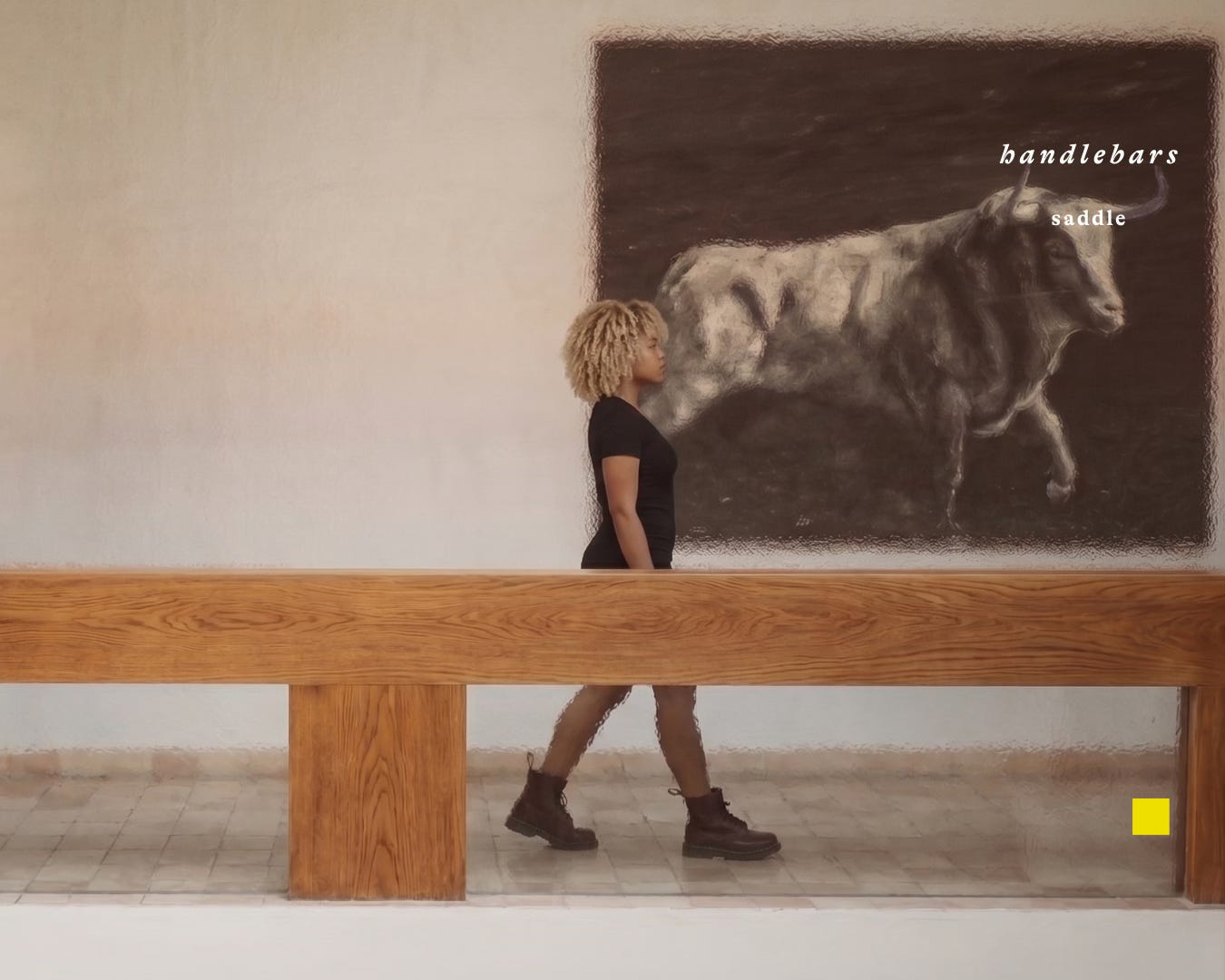
Picture a bicycle saddle.
You see it?
It’s a kind of triangle.
Now stand it upright. Rotate it until one of the points faces down.
Set the handlebars on top. The bar in the center; the ends, opening upward.
There.
Now, yes.
A bull.
A bull’s head.
A saddle and a handlebar. But also a bull’s head.
Still don’t see it?
You can google it:
Bull’s Head. Picasso.
Now that you’ve seen it, let’s talk straight, no fuss.
Picasso didn’t invent the saddle. Or the handlebar. Didn’t do much with them either, if we want to get fancy about it. There’s always some bright spark in the room who reckons anything he didn’t make himself is no big deal.
Picasso took the saddle. Took the handlebar. Turned them, put them together, and saw something the rest of us hadn’t seen.
And now we all see it.
Or, better said, we can’t unsee it.
That’s authorship.
That no one would’ve seen the bull without you.
And that no one looks at a bicycle the same way again.
It isn’t necessarily about creating something from nothing. It’s about establishing a relationship that didn’t exist before. Looking at two known things and producing a new meaning between them. Making it so that, once seen, it looks inevitably obvious.
Grab some popcorn, this is where it gets good, because with the democratization of knowledge, of the tools, of access to the board through social media… in a matter of minutes we can all build a personal brand.
And that’s when authorship starts getting confused with props. Or with personal branding as it’s understood now.
You pick three values. A typeface. Two colors. Yes, one of them neon if you’re brave. You define your tone of voice. You tell your story. You repeat one idea with enough conviction. You take a few photos looking off toward somewhere, thinking about how you angle your right leg so it sits slightly forward and your hands land natural and not like two Lego blocks
—Heyyy!!!
Now you’ve got a personal brand.
Or something close enough to one.
Because that personal brand is going to change the way you’re perceived. The question is: will you be the one to change the perception?
That’s authorship.
And though it looks the same, it isn’t.
With one you’ll be recognizable. With the other you’ll get something recognized as yours.
Something that carries your signature, even without your name.
Authorship doesn’t begin in what you tell people about yourself.
Lovely about section on Linkedin.
It begins with the relationships you’re able to see, the questions you decide to hold long enough, and the decisions you make when no one’s watching. Especially when no one’s watching.
The rest is an about with good lighting. Or a hard flash. If you’re more indie.
The thing is, for a while we all conga-lined to the same little tune.
Follow the leader.
And make it popular. This is a must.
Well, look. Fresh news.
The popular kid in high school also seemed hugely important while we were in high school.
And you reached adulthood a good while ago.
That’s why it cracks me up, all this stuff we love to say now. That influencers are crashing. That brands are losing relevance. All that apocalyptic crap that seems to be leaving with the same force it arrived with. And social media too, of course.
Full Mad Max.
Could be.
What is happening is that the audience is more and more trained. Does a solid crossfit for breakfast.
It’s learned to tell the voice from the template, conviction from pose, and the story from the track record. People have seen enough manifestos that open with a provocative question, enough brave brands using the same neon, and enough vulnerable founders vulnerable at exactly the hour when vulnerability works best.
11:00 AM.
And their assistants, who are the ones starting to search you, compare you, and qualify you, don’t even get me started.
They’re going to sum up in seven seconds that brand story you took six months to approve. They’re going to reproduce your tone by pasting five adjectives into a prompt. They’re going to generate twenty bicycles before the 5 o’clock meeting is over.
Popularity gets you looked at. And it runs on distribution.
Influence changes the way they look. And it’s about introducing a relationship, a question, or a way of understanding the world that keeps operating when you’re no longer in front of them.
It’s not about the feed. Or the prime-time ad.
Picasso didn’t just get millions of people to see his bull at the Super Bowl final.
He got millions of people to never look at a bicycle the same way.
Authorship. Influence.
Your gaze arrives before your name.
That’s why you can have plenty of validation or shitfluence and no authorship. And you can also build authorship for years without getting barely any distribution. Pure recognition.
That’s why, to the ones saying personal branding is dead. I say amen. Fuck. Amen.
Personal branding is the prostitution of authorship. The standardization of it.
Authorship is becoming your own niche. Not because you’ve got a better story to tell. Or a more unique color. Or a voice so your own anyone can reproduce it after reading three pages of instructions.
But because your criterion, your thinking, and your way of understanding the world are able to make something appear that wasn’t there before.
Something the rest hadn’t seen.
And that, once seen, looks like it was always there.
That’s why your signature will be worth more.
The signature isn’t the name placed under the work.
It’s the gaze that made it possible.
Personal branding can get everyone to know your name.
Authorship gets no one to need to read it.
And now try to look at a bicycle the way you used to.
Lines Aja
Brand Strategist & Verbal Identity Consultant — Las Musas
cultooruido.com