

I’ve never played the slots. I’ve never been to bingo. I’ve never set foot in a casino. I don’t have a single game downloaded. Flashing lights don’t do much for me, although I still have memories of arcades, like any kid.
And now I realise I’m developing a bit of a soft spot for a game where the screens aren’t quite what they seem. Every new screen is a new version of me. Except that, if I’m not paying attention, the game starts playing me.
Yes, I’m talking about my friend, the assistant. Or the assistants, plural, because I like doing things as a gang. I’ve never been a one-machine girl.
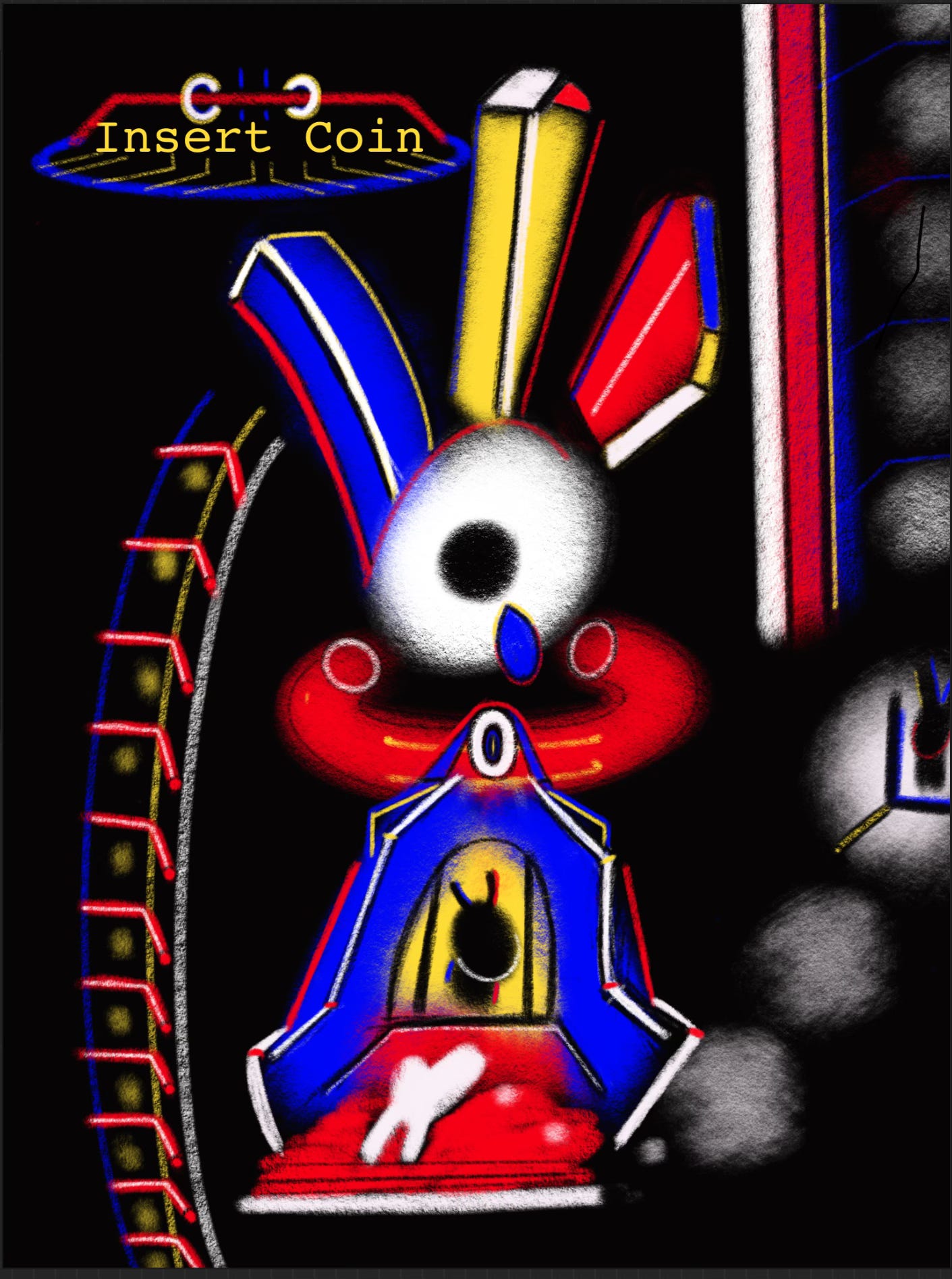
I drew this a few years ago.
It said Insert Coin. Then it became Insert Copy. Today it would say Insert Prompt.
Same rabbit. Different currency.
The machine’s trick is that it fakes continuity.
It hasn’t metabolised what a walk or a nap does to your train of thought. Or to your workflow.
The assistant loads your previous version, the one that still hasn’t digested things properly, and carries on from where you both left off. Without a hair out of place.
Even if it doesn’t remember everything, it still knows where to look for what it considers relevant. Or what you underlined as relevant: “This matters. Keep it in mind.”
Everything you discarded while walking around the neighbourhood or popping out to buy bread, that part it can’t locate.
One of my assistants explained to me that Graham Wallas had already documented something like this in 1926. I hadn’t had the pleasure of meeting the gentleman until tonight. Forgive me. I already have.
Wallas, in my words, says this: first you get into the problem up to your eyeballs. You read, poke, pull at threads, get stuck. Then you leave it alone.
You walk, sleep, go and buy bread. You do nothing, or at least nothing that looks useful from the outside.
—What are you doing?
—Me? Drinking a vermouth.
—Sure? Meh.
Meanwhile your brain keeps chewing on it.
That’s incubation. The background hum.
The bit where apparently nothing is happening and quite a lot is.
You know that sensation you sometimes feel before something lands?
Knock. Knock.
Wallas called that intimation.
Then something clicks. The aha moment arrives.
So there you are, your aha hanging over your head, your heart beating faster. Then you go back to your notes and check whether you’ve actually found something or whether you just got slightly high on your own idea.
I am especially interested in that bit in the middle.
Incubation.
The doing-nothing bit.
The bit where nothing seems to be happening.
And yet.
So: preparation, incubation, illumination, verification.
I was very happy with this explanation.
Then another one of my assistants told me Wallas didn’t go far enough, that the whole four-stage thing was basically: nah.
Suddenly I found myself in a very familiar situation, like being in a WhatsApp group where one friend opens a private chat just to bitch about another.
My answer to both of them was: I don’t have enough context to help you.
I lied.
Now I do.
Which is why I think Wallas’ 1926 book, The Art of Thought, could perhaps include another stage today, a hundred years later: bouncing thought against another surface. Or grinding it until sparks fly, like a skateboard against a rail.
I light a cigarette.
The text box is still empty.
“Continue where we left off.”
That would be the easy thing.
Continue where we left off.
As if it hadn’t rained on Saturday. As if the rain hadn’t made me see things differently. As if the last drag hadn’t filtered anything out.
But I’m not where we left off anymore.
The machine is.
I’ve carried on. Ruminating, filtering, letting things settle, even when I wasn’t sitting in front of the screen.
Every time I say continue, I run the risk of returning to a version of myself I had already left behind.
The conversation keeps everything we said.
I don’t.
Thankfully.
Because digestion isn’t only about taking things in. It’s also about throwing things away. Scrolling through ideas. Then hitting delete, even when it hurts.
Fucking ego.
Maybe that subtraction is judgment.
Which is why starting a conversation with “continue where we left off” might be exactly the opposite of continuing.
Maybe the prompt is different.
“This is what has changed since yesterday.”
Not to bring the assistant up to speed.
To keep myself from falling behind.
Insert prompt to continue.
Your last version is still loading.
Lines Aja
Brand Strategist & Verbal Identity Consultant — Las Musas
cultooruido.com