

I was always more interested in the margins than the books. In whatever emerged from a premise, a scenario, an experiment — more than the formula, the theory, or the name of the academic behind it.
I remember an image: newly hatched goslings following an Austrian man in boots around a garden.
Goslings follow the first moving figure they encounter during a very specific period of their development. It might be their mother.
It might be a pair of boots.
The gosling doesn’t care.
Not exactly.
The gosling can’t care yet.
Konrad Lorenz — the Austrian man — called this imprinting. During a sensitive period of development, the animal fixes on a reference and begins to follow it. It doesn’t compare. It doesn’t look for alternatives. It doesn’t open three tabs and benchmark mothers.
It sees.
It follows.
And something gets written.
What interests me about the goose isn’t that it mistook Lorenz for its mother. It’s that perhaps, before Lorenz, what we call mother didn’t fully exist yet.
There was something unfinished. Waiting for the world to complete it.
And then a pair of boots appears.
The boots don’t take the mother’s place. They help build it.

There are things we experience as natural without knowing why.
Ways of sitting at a table. Of filling a silence. Of knowing when someone important has entered the room. Of saying ‘we should catch up’ to someone you both know you never will.
Nobody had to explain them to you.
You saw. You followed. Something got written.
Then you learned words.
Serious.
Elegant.
Professional.
Expensive.
Cheap.
Brand.
Long before anyone explained to me what a brand was, I already knew how to recognise one. Or so I thought.
I’d seen hundreds. Thousands. Like you. Like anyone.
I knew luxury spoke in a whisper. That technology looked ahead. That craft needed hands. That banks smiled with just enough teeth. That serious companies had blue somewhere and that, if a typeface looked handwritten, it probably sold something made slowly.
Nobody taught me that class.
They didn’t need to.
There were geese ahead of me.
Years later, I learned longer words. Positioning. Archetype. Territory. Differentiation. Architecture. Verbal identity.
I learned to dissect the goose. Measure it. Explain why it walked where it walked.
It took me much longer to ask a simpler question:
What the fuck was I following?
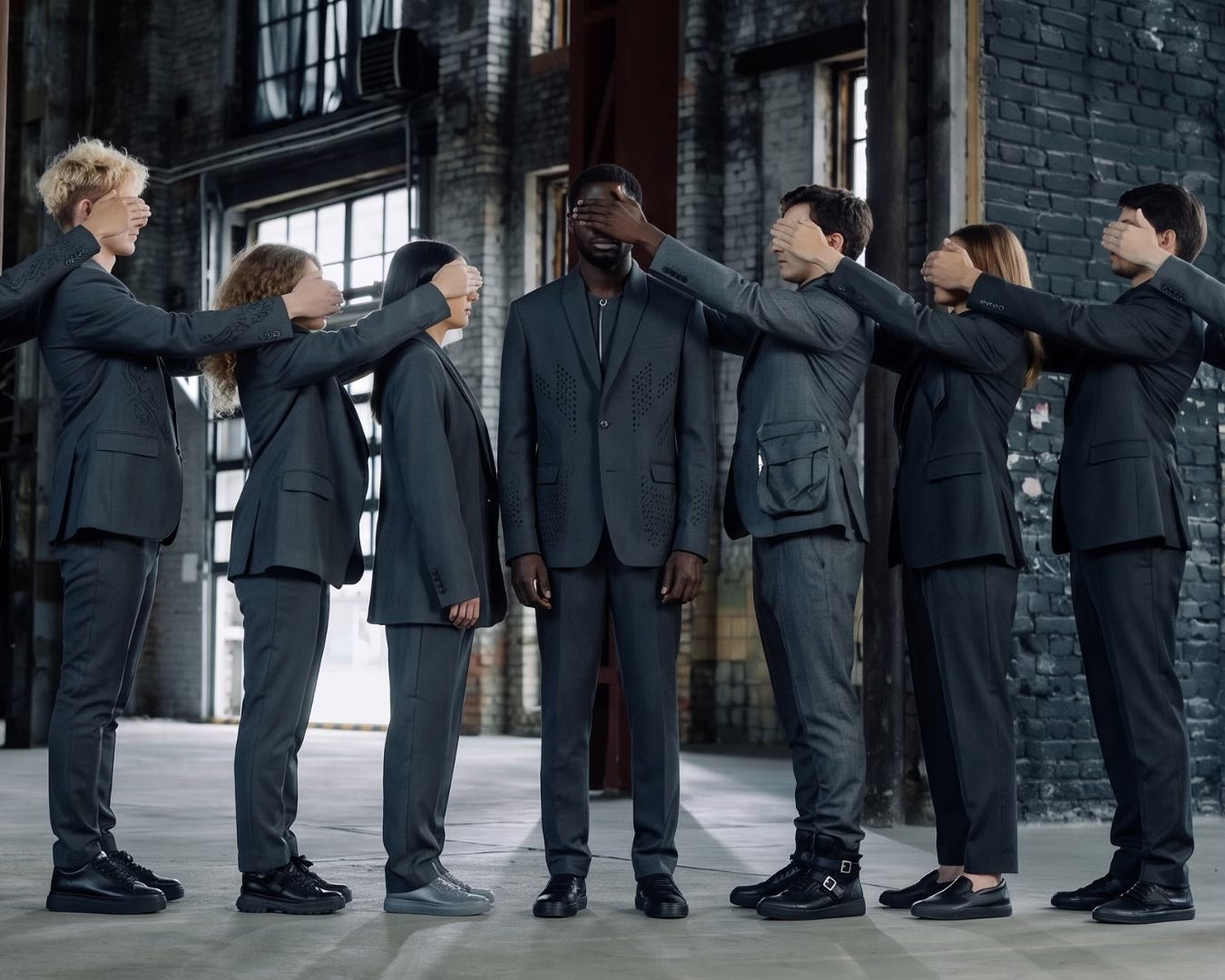
We say a brand needs to differentiate itself within its category. So we do something perfectly logical. We look at the category.
Direct competitors. Indirect competitors. Emerging players. References. Trends. Codes.
We put them together on a slide. Which colours repeat. Which words. Which promises. Which tone. Which shapes. What space each one occupies and which space appears to have been left open.
We watch where all the geese are walking.
And then we ask a newly hatched brand to imagine where it wants to go.
That order interests me.
First, we show it the world.
Then we ask it to think outside it.
A category isn’t just the collection of brands you compete against. It’s a learned way of recognising what belongs and what doesn’t. What looks like an insurance company. What sounds like a consultancy. What is allowed to sell luxury. What an artificial intelligence brand looks like. Which words a bank can say without someone in the room starting to sweat.
Categories organise. And they’re useful. They let us recognise something before we fully understand it.
See.
Classify.
Follow.
The problem begins when we mistake that organisation for the nature of things. When “this is how it's recognised” quietly becomes “this is how it is”.
And “this is how it is” limits far more than a colour palette. It limits the thinkable.

Maybe that’s why some new brands look old from day one.
Not because they’re copying.
Copying would almost be reassuring. It requires an original, a decision and, somewhere along the way, an awareness that you’re reproducing something.
Imprinting happens earlier.
They are born inside a pre-existing idea of what a brand is and devote an extraordinary amount of talent, money and meetings to becoming a different version of something they never questioned.
To the left.
To the right.
A little faster.
With one yellow feather.
Different.
All the while, we keep walking behind the boots.
And then we’re surprised when, after analysing the same references, identifying the same codes and asking the same questions, we end up finding different gaps in the same line.
Maybe benchmarking doesn’t just study the category. Maybe it imprints it.
The part I can’t stop thinking about is that the goose doesn’t see the boots. It sees the world. And later, it recognises something that looks like a category.
A mother.
Or a pair of boots.
A brand.
Or a template.
Maybe differentiating a brand doesn’t begin by asking what everyone else is doing.
Maybe it begins a little earlier. By asking what we’ve learned to consider a brand in the first place.
What we take for granted when we say premium. Professional. Innovative. Approachable. Bold. What images appear before we can stop them. Which boots we’ve been following for years without ever looking down.
Konrad Lorenz died in 1989.
The geese kept walking.
That’s why, when a brand tells me it wants to be different, I don’t first look at where it wants to go.
I look at what it saw when it hatched.
Lines Aja
Brand Strategist & Verbal Identity Consultant — Las Musas®
cultooruido.com