


There’s a moment before Proud Mary starts where Tina Turner stops the band. The bass keeps moving — low, soulful, almost like a heartbeat — but she stops the song. She turns to the audience and explains the method.
You know, every now and then, I think you might like to hear something from us nice and easy. But there’s just one thing — we never, ever do nothing nice and easy. We always do it nice and rough.
And then she sings.
The audience came for a song. They get a manual first. And the manual makes the song land harder, because by the time the rough part hits, you’ve been told it’s coming. Tina didn’t sneak the rough on anyone. She announced it, and then she delivered.
A tagline says here’s what we do. A monologue says here’s how we operate. One is closure. The other is pact.
Easy and rough isn’t a binary. It’s a method that holds both without choosing.
Most marketing operates in one mode. Everything epic, all the time. Or everything whisper, all the time. Brands that pick a velocity and stay there. Brands that confused consistency with monotony.
The real ones modulate. They start easy because the audience needs an entry. They end rough because the audience needs evidence the entry was real. The transition is the strategy. Anyone can be smooth for thirty seconds. Anyone can be loud for thirty seconds. Knowing when to break — that’s the muscle.
But the rough isn’t the loud part. The rough is the part that doesn’t fit. The version that overflows.
A brand that fits has already been processed by someone else. It asked permission before walking into the room. Will this work? Will they like it? Will it scale? By the time those three questions are answered, the brand is someone else’s. Smoothed. De-edged. Acceptable.
The brand that doesn’t fit is the one nobody asked for — including, often, the founder. The version that arrived without invitation. Louder than expected. Longer. More specific. More itself than the room was ready for.
It overflows. It doesn’t land cleanly. People stumble on the way out.
That’s the brand worth building.
Nice doesn’t sediment.
Nice doesn’t become folklore. Nice doesn’t end up as a story you tell someone three years later in a kitchen at 2 AM. Nice gets forgotten the moment a slightly louder thing walks into the room.
The brands that stay are the ones that broke something on the way in. A door. A category. A convention. A face — yours or theirs.
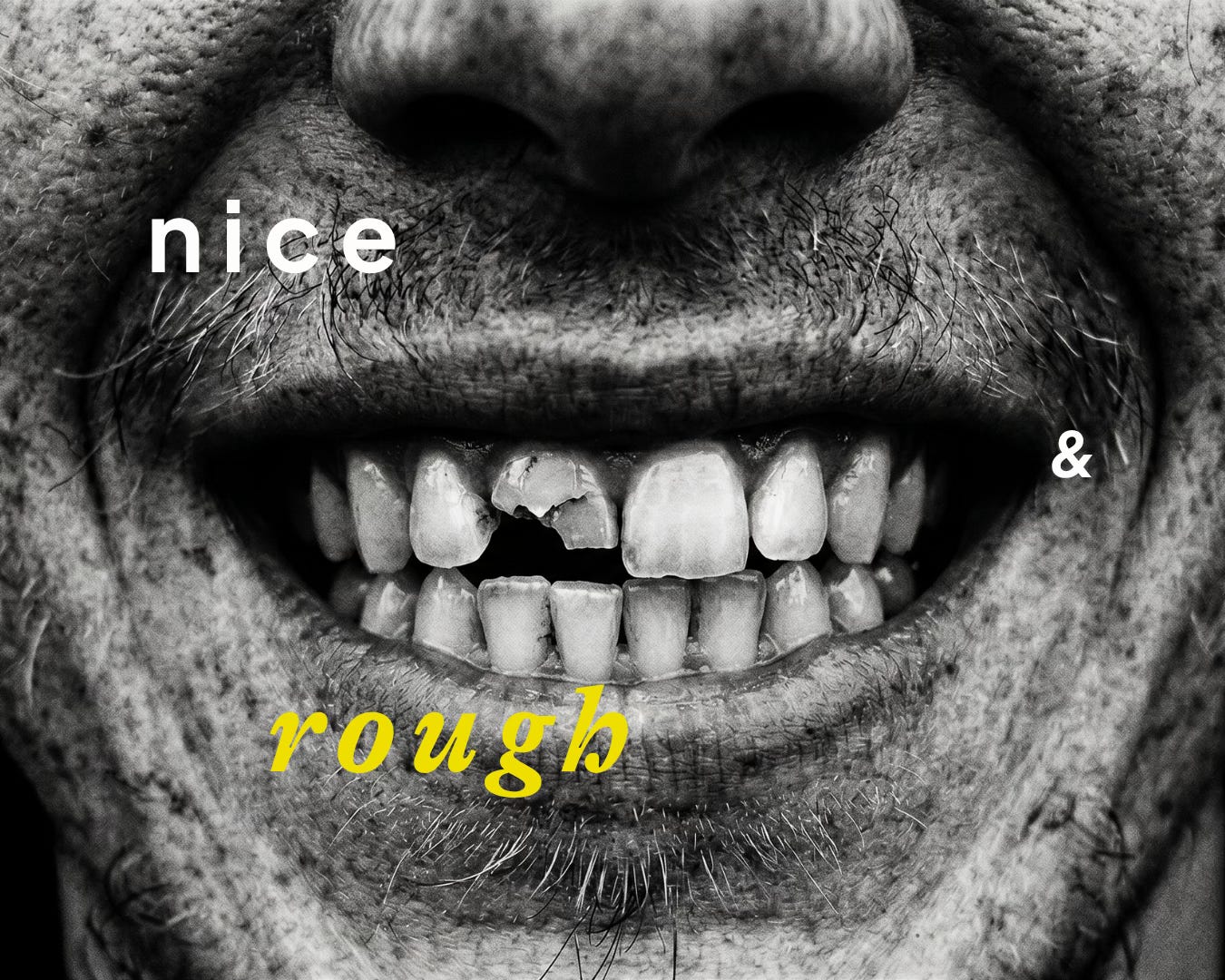
You don’t get to be folklore by being smooth. You get there by leaving a chipped tooth somewhere along the way.
The hardest part of branding, the part nobody sells you in a course: the brand only becomes itself in the version that doesn’t fit. The version the founder, on a bad day, will want to soften because someone called it too much.
Too much is the early warning system of finally.
It’s the version where the metaphor went one inch further than it needed to. Where the typography broke the grid. Where the founder said the thing in public she usually only says at home.
That’s where the brand lives. Not in the cleaned-up second draft. In the first draft someone almost talked you out of.
Tina Turner ends Proud Mary on her knees most nights. Not as performance — as consequence. The song asks her to. She gave it speed, and the speed asked for the body, and the body answered. By the last chorus, she’s not selling rock anymore. She’s surviving the rock she made.
That’s the rough.
Not loud. Not aggressive. Rough in the original sense — uncut, untamed. The version that got there without being polished by anyone else’s hands. The version that breaks when it lands because it had to throw itself in to land at all.
A brand that ends rough paid in full for what it said.
A brand that ends easy paid for nothing — and that’s what it’ll be remembered as.
The truth of a brand isn’t in the version that fits. It’s in the one that doesn’t. It’s in the overflow. In the part that breaks.
It’s in the moment Tina stops the song to tell you what’s coming, and then keeps her word.
You roll on the river.
You don’t ask the river to be smooth.
Lines Aja
Brand Strategist & Verbal Identity Consultant — Las Musas®
cultooruido.com