

Most labels start as descriptions
Some end up writing you.

We all categorize.
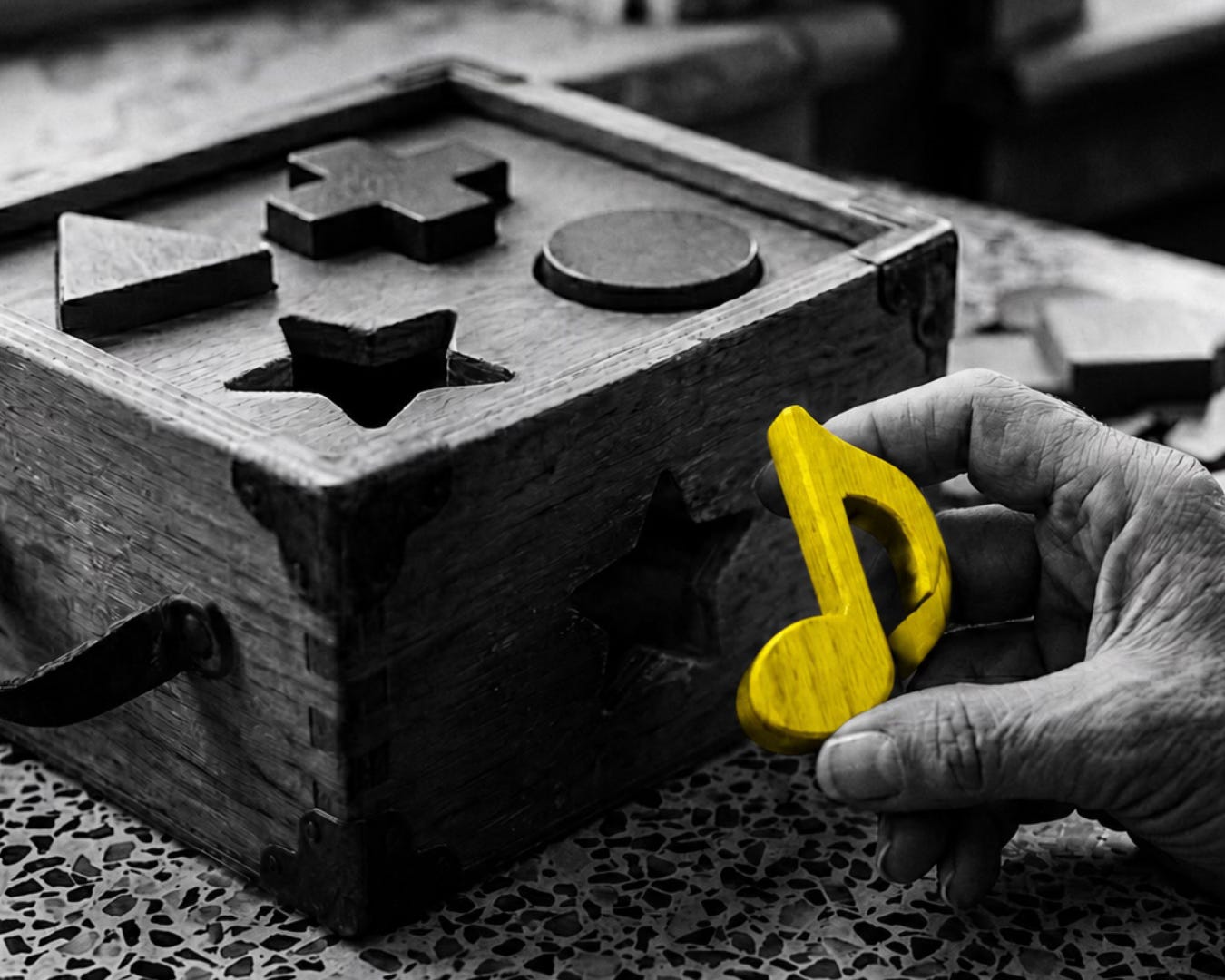
We start as toddlers: every element within its set, the block into its slot. Calling things by their name, even when the names are left orphaned of meaning and the meanings never get named.
We categorize, we label, Dymo gun in hand.
When they categorize you and you don’t accept the category, you do one of two things: you swallow it whole, or you start, from the margins, building your own boxes. The ones that never close.
They categorized me, of course.
First as a girl: communion dress, pink bike with a basket, when what I wanted was a BMX, and that you’re prettier when you’re quiet. The category had decided for me before I knew how to ask. But the desire was already made of clay. It was already looking for the dirt slope, not the paved sidewalk.

Girl. Daughter. Sister. Student. Friend. Girlfriend. Partner. Bankrupt. Founder. Insert here the label that was hardest to let go.
They categorized me so much that, without a label hanging on me, I didn’t know who I was.
Then I had to carry them. Live up to them. Because labels aren’t worn: they’re obeyed.
They categorized even my sensibility. And they graded it.
When I was small, I wanted to play like Stevie Wonder. To smile like him, and have others smile back at me as wide as I did watching him arpeggiate.
I wanted to be Stevie.
But that desire walked into the conservatory and came out turned into exams. Scales. A jury. The conservatory was to my musical instinct what the pink bike was to the BMX: it took a shape that didn’t fit the mold and forced it into a slot that was never its own.
I complied.
I complied with the exams until I thought I’d amortized the instrument.
Nobody called it that, but the math was there. That black piano leaning against my bedroom wall reminded me that the size of my urge to quit was inversely proportional to the cost of quitting, in terms of disappointment and return on investment, according to the table I’d drawn on staff paper long before I knew what an amortization schedule was.
Every year added hours, exams, expectations, and money. Every year made it harder to ask whether it was still mine.
Because there comes a point when you no longer continue out of desire. You continue because you’ve invested too much to walk away.
A move and a divorce made me feel the cost was charging interest. Slowly I realized the debts I was taking on weren’t mine. Except for a handful.
Most belonged to the labels: the ones squeezing me from outside and the ones I took on from within, straining to fill them.
A first year of music theory. Theory only. Not touching the instrument. Talk about a trial by fire. But I thought: with two years of theory and one of piano I’ll have all the offbeat quavers I need to build my own Superstition.
It never happened.
Because categories do more than order. They also shape. Wear down. Prune. And when you stay inside one too long, you end up mistaking sensibility for compliance.
The category taught me to read scores. Little by little I stopped playing it for myself: I began to execute, with nothing running through me, to be validated by a jury.
Until one day I discovered the cost hadn’t been the piano. Or the hours. Or the money. It had been that part of me. The one that wanted to play offbeat before someone turned the desire into a file.
The file kept the piano.
The offbeat came with me.
Because that was what had hooked me when I was barely knee-high and didn’t belong to the instrument: the instrument was just the slot they shoved it into.
My Superstition never sounded on a piano, but it sounds in everything I do. Still not landing where the beat expects it, so it can come in offbeat.
Because labels should be like that syncopated quaver. A box that never fully closes.
Lines Aja
Brand Strategist & Verbal Identity Consultant — Las Musas
cultooruido.com