

How many grains of sand make a heap? How many posts, essays, messages, calls, deliverables? How many yeses? How many noes? Is it the tagline? The logo? The latest slogan for the autumn campaign?
I’m going to tell you about Greece. About paradoxes, and a man who collected them.
In the fourth century BC, Eubulides of Miletus came up with a paradox that still has us scratching our heads. The Sorites paradox. From the Greek sōrós, meaning heap.
Imagine you’re at the beach. Look at those grains of sand. One white, another almost black, bits of crushed shell. The crab? No, that one doesn’t count.
Do a thousand grains make a heap? A thousand and one? Is it grain one thousand and two that makes it a heap, or was it nine hundred and ninety-nine? Maybe earlier. Or later.
If a single grain doesn’t make a heap, why should adding one more change anything? And another. And another.
Ask anyone, and the threshold shifts. But at some point, we all seem to agree. We’re no longer looking at grains. We’re looking at a heap.
At the beach, you don’t see a heap. You see one enormous heap. And that sandcastle the kid has built by the shoreline? A heap shaped like a bucket. On your towel, under your head, you can feel the shape of the little mound you’ve made into a pillow.
Grains forming a heap. Heaps made of grains. And yet they keep slipping through your fingers.
You start taking things away. One less post, one less essay. One platform you leave, another you decide never to join. Before adding another, you realise you might not have needed quite so much to make a heap in the first place.
Fine, not everyone will agree. Along comes another expert, the guru who smashes every metric, a new school of thought, a new tool, a new trend. And suddenly you’re wondering whether your heap is enough, or just a sum of grains.
I don’t have the answers. If I knew exactly how many grains it takes to make a heap, I’d have solved a paradox that’s been around for twenty-four centuries.
I haven’t had enough coffee. Yet.
The heap. Your identity.
Think about your heap. Your identity. Verbal, visual, symbolic, attitudinal. How you express yourself, what you represent, what you stand for and what you do.
Your tone, your voice, your messages. Your logo, your colours, your art direction. The codes you make your own. What you give your blessing to. What makes you wrinkle your nose, and you don’t hide it. What makes you one way and not another.
Bring it down to earth. How you communicate that identity, how you activate it, how strategy becomes tactics.
Everything is fragmented. You see grains: posts, clicks, comments, stories, essays, notes, emails, calls, ads, workshops, talks on stage. A carousel. The other one you deleted because nobody engaged with it.

Decisions. One after another.
When you approve a campaign. When you launch your website. When you decide to take a stand. But above all, the decisions that come with no glamour and no champagne corks popping. The ones you make on any given Tuesday at three in the afternoon, while it’s raining outside.
Thinking. Overthinking. Bordering on neurotic. Because everything counts. Because everything carries weight. And still, we seem to need more and more grains before we can recognise a heap.
More platforms. More touchpoints. More tones of voice. More fragments on display. Less control. Faster forgetting. Fewer clicks. More scrolling.
But when you look at them together, when you stop long enough, you recognise the shape of the heap. You recognise which grain belongs to which brand. Whether the work has been done.
Because you’re not just accumulating grains. A new, recognisable shape emerges. Something that wasn’t in any of the parts on their own, yet is made of all of them. An identity
The cobbler’s children have no shoes.
We spend our days looking at other people’s heaps.
With clients, we see it clearly: which grain doesn’t belong, which one’s missing, what shape the thing they’re building is taking.
With our own, we count. How many posts this week. How many likes. How many new followers. And we leave it at the bottom of the list, for when the clock stops biting.
Becoming your own first client means looking at yourself with the same eyes you use for everyone else. Giving your heap the same time you’d give anyone who’s paying you.
That’s when you stop counting grains. You start seeing the heap. Recognising how those decisions, big and small, answer to the same voice, the same presence.
Give or take a grain.
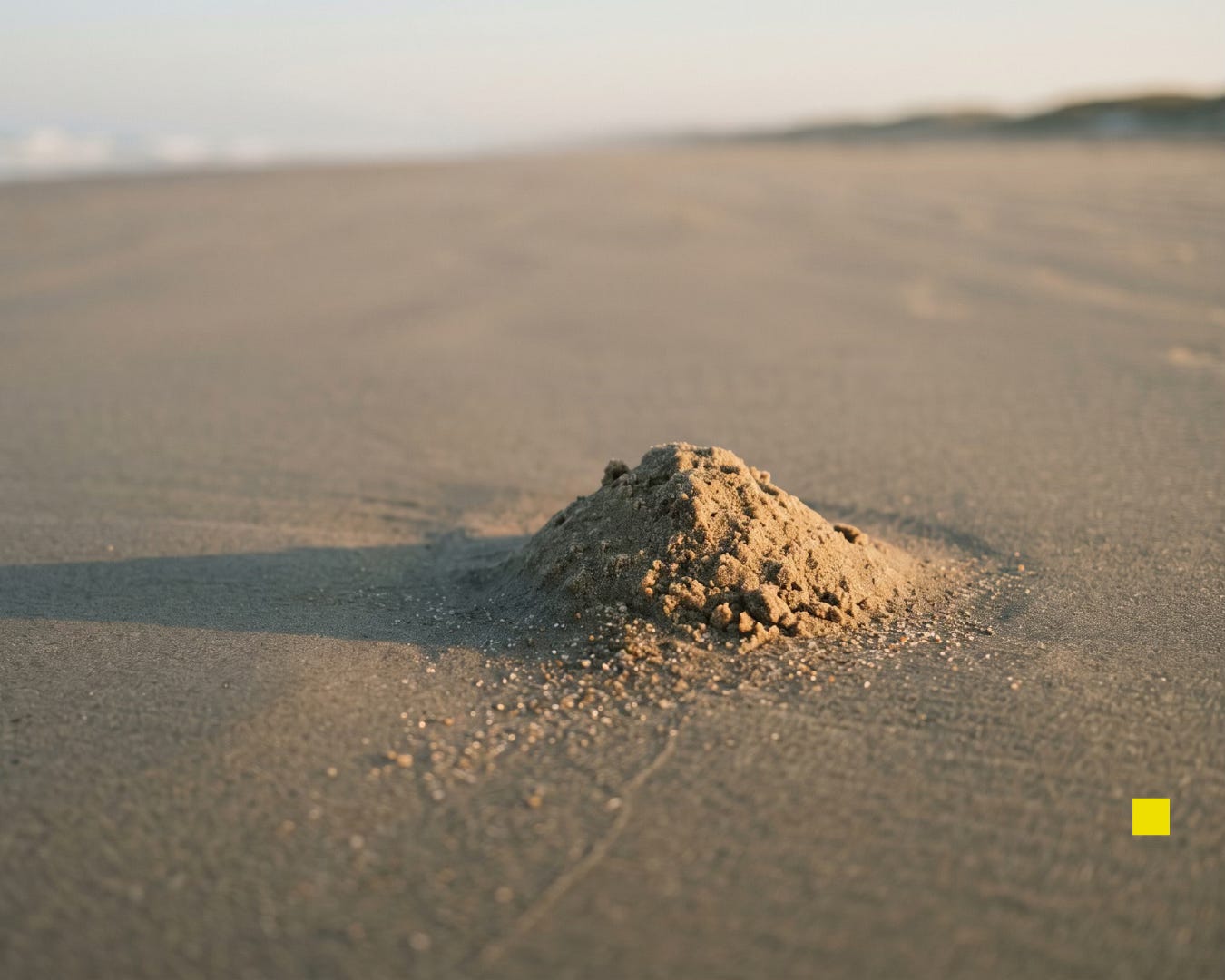
You’re back at the beach. You play with the sand between your fingers. It slips away. You smooth the surface beside your towel. Gather a little under your head.
A little more here. A little less there.
Until you can rest your head.
You haven’t counted the grains. You don’t know how many you could take away before the shape disappears.
But you know it’s there.
Maybe that’s what your heap is. Somewhere to rest your head. Without feeling like you’re floating in a space that doesn’t belong to you.
Zoom in. Do you see grains, or a heap?
Sorites walks into a bar. The bartender asks:
“What’ll it be?”
“Identity. Large. No sugar.”
“Give or take a grain?”
“Take. And counting down.”
Lines Aja
Brand Strategist & Verbal Identity Consultant — Las Musas®
cultooruido.com