

I still remember that statistics book. I hated it with all my strength. Antimatter, in a 343-page edition with a blue spine. I ate the whole thing, chips and all, for the sake of a curriculum. Not because I chose to.
The truth is, I never understood what it was supposed to add to my development. It felt like punishment. Anti-pedagogy on paper: formulas with nothing on and obscenely tangled examples.
So I’m going to talk to you about statistics. My way. So we understand each other and, above all, so I don’t lose myself.
I’ll do it with a prao—what we call a meadow up north—and a good flock of xalda sheep.
See the prao on the left?
Good grass, uh?
Green shoots.
And the sheep. Pretty things. Well padded.
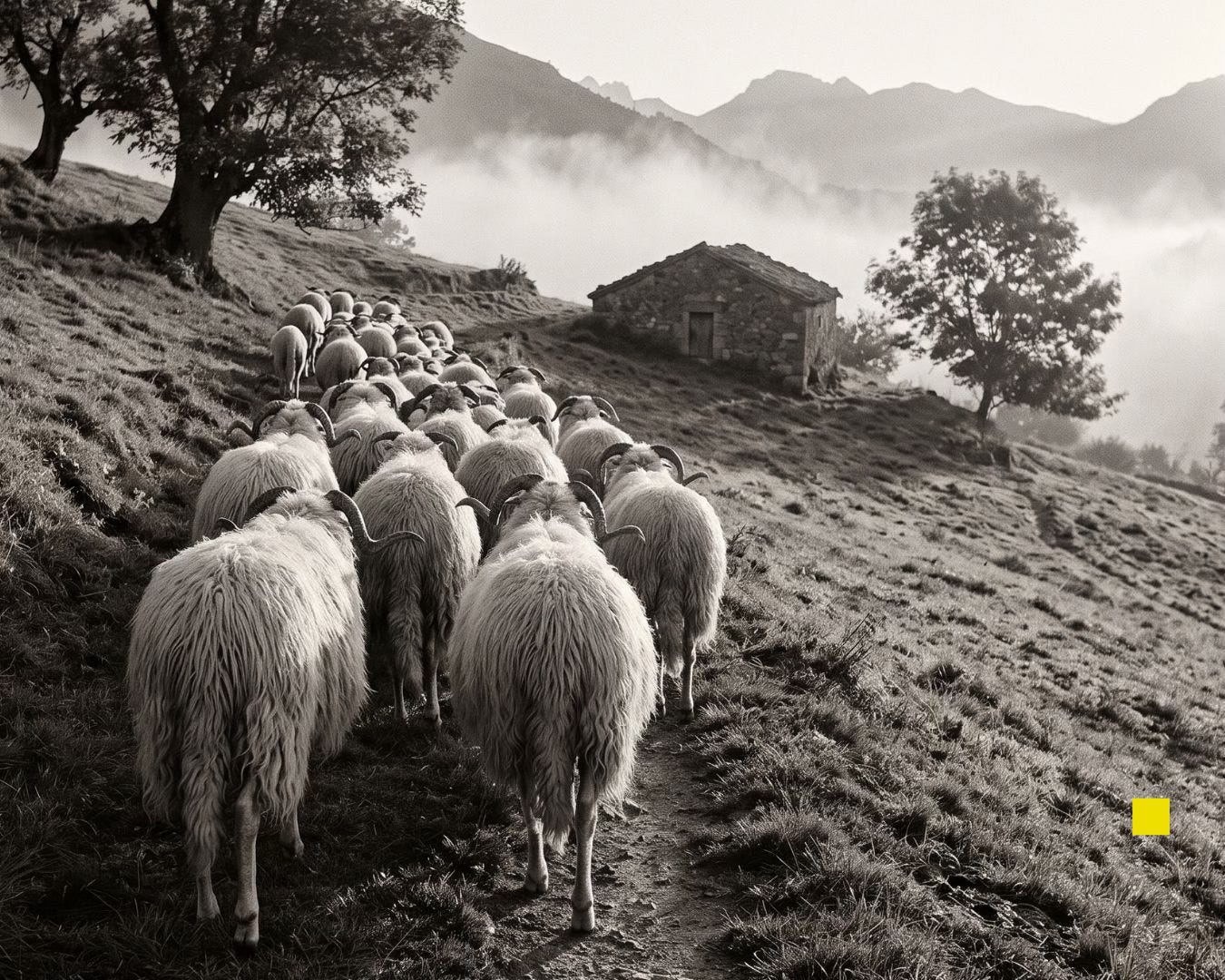
Here’s how the sheep spread out across the prao.
Small huddles. Bulging huddles. Sheep scattered about.
And until very recently, there was one glorious huddle. The biggest.
In it, the good old corporate xalda sheep
The huddle everyone wanted to be in.
The blue: sober. Trust in bold. A photo of a handshake. Red tie. Discreet typeface. More than twenty years offering comprehensive solutions. They put the customer at the centre. And lead the future through excellence.
You can’t tell exactly what they do, because their brand message is more of a hum—or a litany—than something with punch and precision. But they project solidity.
Or so it says on the website.
This was the mode.
The big huddle.
Where almost everyone grazed because that was where almost everyone grazed.
“We’ve always done it this way. We’re good sheep. Baaaaaa.”
Fair enough.
Good grass, little risk, plenty of company. The board approves grazing there without much trouble because it seems safe, even though the numbers are getting tight: more investment every time, less return.
Logical.
Because the problem with a huddle is that it’s a huddle. Lots of sheep squeezed together. Like a metro platform at rush hour.
So, for anyone to hear what you have to say, you need to bleat louder than the sheep next to you.
Only the sheep next to you…
Well. It offers the same comprehensive solutions, with the same vocation for service and the same red tie. Yes.
Yes.
Only with a bigger budget.
The algorithm bends the numbers
Then artificial intelligence came along.
We trained it on what we’d already made.
Seeds for the parrot.
Websites, ads, manuals, tones of voice and every handshake the stock photo libraries could hold.
We asked AI to learn.
And it learned all right.
So when we asked it for a corporate brand, it gave us back the mode: trust-blue, comprehensive solutions, the customer at the centre, the next level.
Then came “differentiation” as promptable standardisation.
“Make it different. Make me different.”
And the algorithm, the bloke with the wheelbarrow, changed the sign on the sack of hay.
And the new corporate sheep appeared.
Disruptive. Innovative. Viral.
Lowercase name. Bold typeface. Hoodie. Fluorescent gradient. A deliberately imperfect illustration and a tone that treats you like its BFF before it knows your name.
“Mate.”
This specimen doesn’t offer comprehensive solutions. Its thing is breaking the rules.
Of course it says fuck. Because, according to page 14 of the manual approved in a meeting, that’s what it takes to be cooler.
Pure personality.
Oh, yeah.
The new corporate sheep looks like it escaped from the first flock, the trust-blue one.
And it did.
It was lovely. It was strategic. It worked.
Until AI learned again.
The lowercase name. The font with “character”. The neon gradient. The “no bullshit”. The founder you could have a beer with. The company that had stopped looking like a company and started looking like a stage full of rockstars.
First, one sheep crossed the prao.
Then another.
Then a thousand.
Beeeee yourself.
A thousand sheep bleating be yourself, pressed up against one another. Identical. They thought they’d got away. They’d moved to the other side of the field.
Ask a prompt for differentiation often enough and you get a second huddle.
There used to be one mode.
Now there are two.
The old corporate sheep, red tie.
The new corporate sheep, hoodie.
Two modes. Two huddles calling themselves different.
Same bloke. Same wheelbarrow. New outfits.
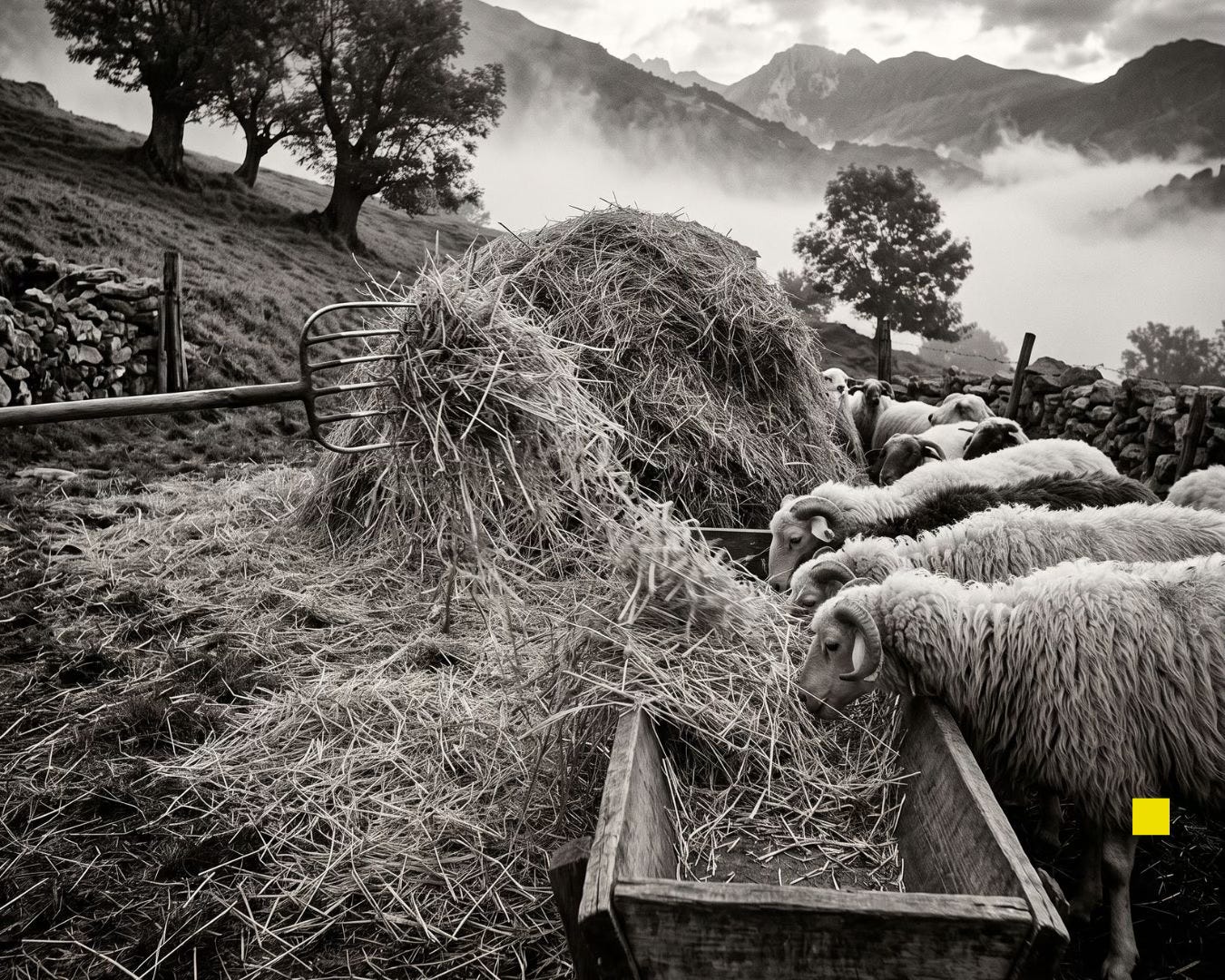
The mirage thing (la movida)
AI takes a provisional sample.
“Morning! Analyse this sheep in my industry. Looks like it’s found its blue ocean.”
Then it makes more of them.
It spots the huddle. And starts adding sheep.
It helps it grow.
When we ask for differentiation, it does the same thing to the edge. To what used to be extreme. It reproduces it until it becomes a second huddle.
Baaaaa turns into beeeeee yourself.
The mode of not being the mode.
So now, with two nice fat huddles of sheep and a bimodal distribution, the mean falls somewhere between the flocks. An apparently sensible point—neither with you nor with that lot—where there might not be a single sheep grazing.
In the middle of the prao.
It’s the mirage of the “middle ground”—that beige zone where you think you’re finding balance, but the stats aren’t giving you a solid place to stand, they’re just giving you an average.
On top of that, the average isn’t fixed. It’s like a rubber band that stretches whenever someone screams from the extreme.
And that’s when you need to grab the popcorn, because the incongruity hits.
All it takes is one weirdo sheep—a death metalhead or some TikToker with enough clout or a Martian one—to step into the frame, and suddenly “classic, but with personality” means something totally different than it did two years ago.
So different that what you used to fix by loosening your tie—or taking it off altogether—now turns into another scene:
The CEO of the first flock looks towards the second.
“Shit. We’re falling behind.”
Team meeting:
Comms opens TikTok. Strategy opens Excel. The agency joins on Zoom —where is the link?
Three months later… Antonio, the CEO, is holding a burger in front of the camera while an intern teaches him the choreography.
“More natural, Antonio.”
Antonio doesn’t understand why Comms wants him to dance. He does it anyway.
Guess why?
Because the data is there.
The result:
A casual selfie with the burger.
—Extra pickle. Thanks.
Choreography that doesn’t belong to him. The staff doing backing vocals because “it’s good for the company”.
Hey, TikTok.
—Antonio, that arm a bit higher. And smile more naturally.
And Antonio shakes his bones, eats the burger and swallows his own judgement (and maybe a bit of his dignity) because the data… is there.
And no one takes responsibility because, when every decision is backed by data, no one seems to have made it.
Touché.
The result is a thousand sheep bleating be yourself.
The bank stops calling you sir or madam and starts calling you “person”. The energy company plants an illustration of a leaf next to the word future. The B2B startup writes “No bullshit” above fifteen lines of bullshit. The founder posts the 13 lessons he learned from spending 48 hours in Quebec.
And someone writes “we’re not for everyone” using the same template as everyone.
So, if you look properly at the prao—or the market—there are two flocks: the old one and the one made up of those who ran away from the old one.
And then there’s the obstinate sheep.
She isn’t a unicorn.
She’s a sheep.
Obstinate.
Because no one outdoes her at that.
—Excuse me. I’m a visionary. Always have been. It comes naturally. Woof. I mean baaaaaa.
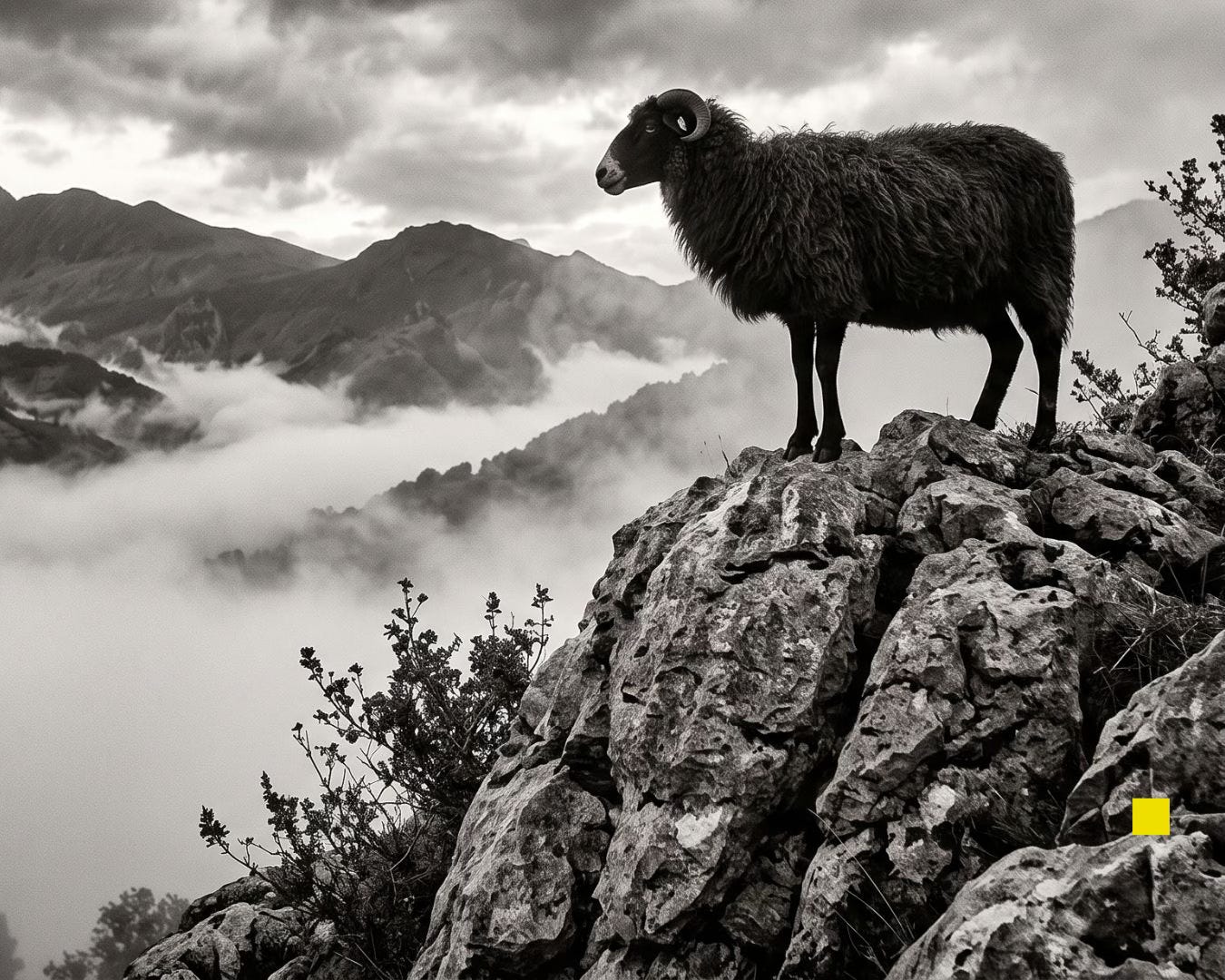
While the others eat together, she has to find her own grass. Sometimes she finds better grass.
Sometimes she doesn’t find a fucking thing.
Sometimes she goes over the cliff.
She’s one of those who arrive early and still have to wait. She holds a position with no data to back it up.
And that’s no guarantee of anything because without data, well…
Besides, being obstinate doesn’t guarantee you’re right. It only stops you hiding behind the flock when you’re wrong.
Maybe your place is at the edge. Yes, there it is. Go on. If you’re obstinate, all the better. But walking the wire has a cost. And not everyone can bear it.
Statistics can tell you where the market is. Not where you should stand.
They do warn you when the “weird” place has a queue at the door. And the drinks cost three times as much.
The centre, if it’s yours, can be strategic.
The edge, if it’s yours, too.
But don’t let anyone sell you being yourself as a tone of voice.
Being yourself is a place.
And a place always costs you.
That’s why you can’t bleat be yourself without being it. The slogan doesn’t make the bill disappear. And that fancy personality without a position is just another outfit.
The difference between being flock and being obstinate is the cost. And whether you have it in you to keep paying.
Data can tell you where the flock grazes. Strategy decides which prao is yours, what it costs to stay and what you won’t do even if every sheep runs towards the hay.
The algorithm can reproduce the same old baaaaaa or the beeeeee yourself.
It couldn’t care less.
Both come from the same wheelbarrow.
But the sheep, the brand, the business, Antonio and the people behind it pay the cost of trading grass for hay.
And that won’t do.
Baaaaaa.
I mean.
Meow.
Lines Aja
Brand Strategist & Verbal Identity Consultant — Las Musas®
cultooruido.com