

If I say Be well, it might mean a lot to you, as an English speaker. To me, not much.
In the Spanish dub, Be well became Propicios días. Back into English: Auspicious days. Say that and I see Demolition Man. Sylvester being Sylvester. Wesley being Wesley. And a society that was a projection of our own.
Everything hygienic. Measured. Calibrated.
Like LinkedIn’s algorithm, the same one that lets someone promote AI slop. Or Meta’s, which is scandalized and blocks you if you say the word tits, but allows bots and adult accounts ("check out my profile!"), while it keeps the population in line, one measured scroll at a time.
There, Arnold was president. Here, he was governor. Now he does ads for garden tools, and I’m a self-declared fan.
Auspicious days is what you say to your assistant every time you talk to it as if it weren’t a garden tool. And it says it back.
Auspicious days!
That’s how the latest email from that client begins. Just like that. Casual. First thing in the morning.
The assistant interprets the client’s interpretation. And, with luck, the file you sent on Friday. On Monday you have breakfast with three rounds of revisions on something you’d closed last month. And a small suggestion. That it came up with. Just like that. Casual.
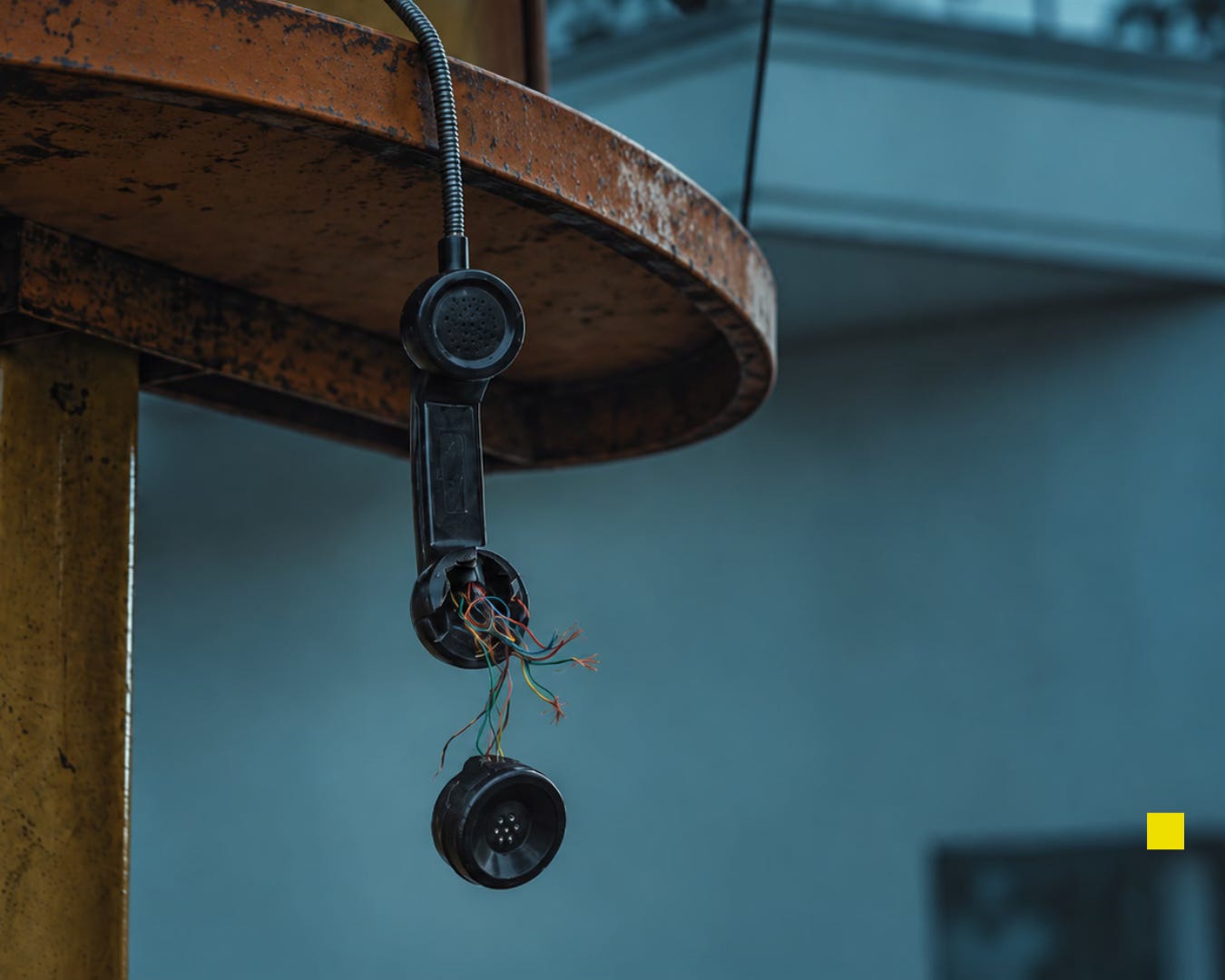
You probably remember broken telephone.
Everyone in a circle. One sentence kicked things off: Grandma went out on her bike. The next person heard it and passed it on to the one beside them. And so, ear to ear, the message warped. Grandma went out on a hike. Grandma went out to get high.
Not because anyone wanted to change it. Because everyone was trying to tune their ear and understand it before passing it on. And because it went through a filter: their own wiring.
A word that sounded like another. An added intention. A nuance that wasn’t there. A well-meant correction. Another coat of varnish.
Until the sentence reached the end as something else entirely.
Now we’ve improved the game.
You send the client a proposal. They run it through their assistant to understand it better. The assistant hands it back, understood, with whatever context the client gave it and, for better or worse, with your proposal attached. And at the end of the circle there’s you, on a Monday, with three rounds of revisions to dunk in your coffee.
No sugar, please.
And that’s where the loop begins, because the assistant has all the answers.
But the exam questions, does the client know those?
Yes?
Then why hire someone to take the exam for you?
It’s not a rhetorical question. Well. A little. Because using a tool to understand a decision better is one thing. And something a little, well, quite a lot different is using it so you never have to make one.
That’s where the All-Inclusive begins. Wristband and free mojitos:
Why this headline? Why not another?
Wouldn’t it be clearer to explain it this way?
What if we add this?
What if we use green instead of red?
Sure.
It might.
So you start shaking the Magic 8 Ball and everything turns provisional. You need to buy a sofa. Well, don’t ask the website’s assistant, or you might end up buying a hammock. Do you think a chaise longue will still meet your current needs in three years? Does beige work with more than grey?
More questions, more indecision. More fear of making the wrong call. More frustration. And more days.
Until now, it wasn’t like this.
You had to call someone. Meet. Look things up. Wait for an answer. Bother the agency, the consultancy or the furniture guy again. Admit, even, that maybe you were beating around the bush.
Not anymore.
Now you can ask for a second opinion before you’ve finished reading the first, because two paragraphs into the wall of text it throws at you, you already know it’s not that. Then a third while you turn on the shower (everyone knows things flow better in the shower). And a fourth when you switch on the hairdryer.
And they’ll all arrive neat, rounded off. In a row. With arguments. With nuance. With sources, even.
And with that dignified, reasonable tone the little machine takes on right before it complicates your morning. Hey, remember that thing you thought was closed? Fresh news. Check your inbox.
And yes. Of course.
Everything can be improved. Endlessly.
But time runs out. And you get tired. Tired of overcomplicating that CTA. The machine doesn’t get tired. Sometimes it asks for your credit card number. That’s all.
Strategy isn’t about finding the option no one can object to. That option doesn’t exist. It’s about knowing why you choose one, and what you’re willing to lose by choosing it.
That last part tends to get forgotten.
Every decision kills something. Choosing one word discards a hundred. Choosing a position leaves others out. Choosing a direction means no longer exploring the others, even if they were interesting, intelligent and perfectly defensible too.
That’s why deciding is a lot scarier than asking.
—So, grey or beige?
—What if I regret it?
—There are several perspectives to consider. Have you considered terracotta?
Auspicious days.
Lines Aja
Brand Strategist & Verbal Identity Consultant — Las Musas®
cultooruido.com